

SinConvex
SinConvex® is a mixing helix developed by amixon® for vertical powder mixers. Its name is derived from the sinusoidal convex geometry of the mixing elements and flow surfaces.
The SinConvex® principle creates a combined flow of displacement, circulation, and local vortex effects. Powders and granules are homogenized with high mixing quality despite a very low rotational frequency, resulting in only low shear stress. The inclined geometry also supports the self-cleaning of the surfaces and promotes efficient residual discharge.
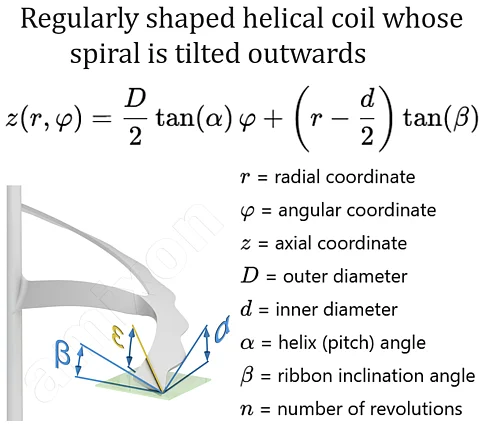
A vertically arranged helical ribbon can be well described in cylindrical coordinates. The outer radius is D/2 and the inner radius is d/2. The ribbon edge runs upwards in a helical shape. The pitch measured on the outside is defined by the angle α. The axial pitch results from the tangent relationship. The axial height at the inner ribbon edge in Word notation is:
z_(inner)(φ) = (D/2) · tan(α) · φ.
- z_(inner)(φ) = axial coordinate at the inner ribbon edge
- D = outer diameter of the helical ribbon.
- α = helix angle (measured from the horizontal, on the outside).
- φ = angular coordinate (in rad) around the vertical axis.
- The inner radius is constant.
- r_(inner) = d/2
- The outer ribbon edge is at:
- r_(outer) = D/2
The helical ribbon is tilted outwards. The tilt angle from the horizontal is β. This results in an additional height difference across the radius. This is assumed as a linear function of r. The general equation for the ribbon surface in cylindrical coordinates (r, φ, z) can then be formulated in Word notation as follows:
z(r, φ) = (D/2) · tan(α) · φ + (r − d/2) · tan(β)
- r = radial coordinate, with d/2 ≤ r ≤ D/2.
- φ = angular coordinate around the vertical axis.
- z(r, φ) = axial coordinate of the ribbon surface
- D = outer diameter of the helical ribbon
- d = inner diameter of the helical ribbon
- α = helix angle (outer pitch from the horizontal)
- β = tilt angle of the ribbon outwards (from the horizontal)
At the inner edge (r = d/2), the equation simplifies to:
z_(inner)(φ) = (D/2) · tan(α) · φ
At the outer edge (r = D/2), the result is:
z_(outer)(φ) = (D/2) · tan(α) · φ + (D/2 − d/2) · tan(β)
Thus, the tilted helical ribbon with inner and outer edges is fully and compactly described in cylindrical coordinates.