

propellant
A blowing agent is a substance that releases gas upon heating, depressurization, or through a chemical reaction. The resulting gas creates pressure, expansion, or a porous structure in the material. Blowing agents are used to foam, expand, or loosen solid or liquid materials.
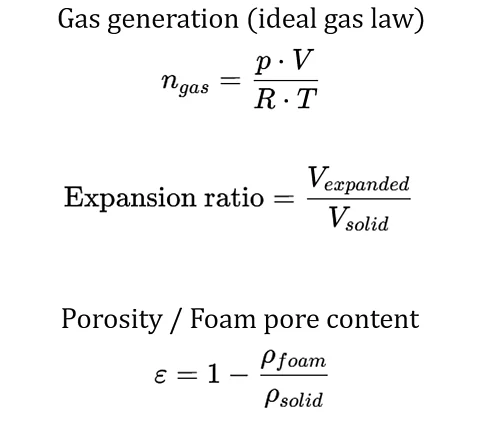
- ε is the porosity or void fraction
- ρfoam is the density of the foamed material
- ρsolid is the density of the solid material
Blowing agents can act physically or chemically. Physical blowing agents are already gaseous or low-boiling. Examples include CO₂, nitrogen, or pentane. They expand upon heating or depressurization. Chemical blowing agents decompose when heated and release gases such as CO₂, N₂, or H₂O. Typical examples are azodicarbonamide or sodium hydrogen carbonate.
Blowing agents are used in the plastics, construction, chemical, food, and detergent industries. In plastics and building materials, they produce foams, porous materials, and lightweight materials. In baking mixes they serve as leavening agents and create porous dough structures. In detergents and cleaning products, they support dissolution, foaming, and active ingredient distribution.
Blowing agents affect density, thermal conductivity, mechanical properties, structure, and product performance. In process engineering, they are an important component of material finishing and the structuring of materials.
 Related pages