

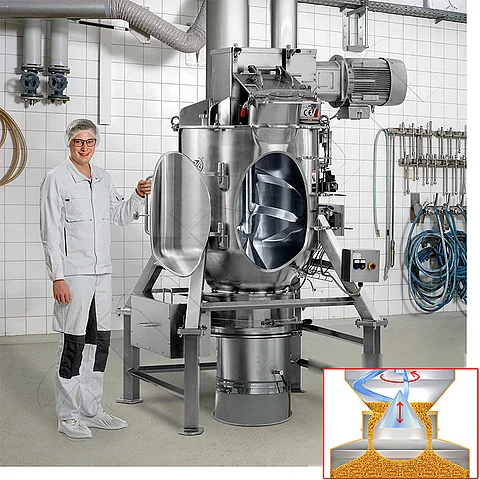
Processing mixer
The term “processing mixer” is not clearly defined and can encompass a wide variety of equipment and process steps. At amixon®, we use the term to refer to precision powder mixers in which the actual mixing process is combined with other process engineering functions. These include, for example, deagglomeration, wetting, coating, granulation, dehumidification or chemical synthesis. The solids may be present in a dry, moist or suspended state.
In practice, a powder mixing process is never free from accompanying effects. Depending on the mixing dynamics, these effects can be specifically promoted or suppressed.
The processing methods used during mixing vary considerably from one industry to another, as each is characterised by different material properties, process objectives and quality requirements.
In pharmaceutical galenics, the focus is on the homogeneous, fine dispersion of active ingredients in excipients. Key processes include deagglomeration, trituration (disaggregation) and the achievement of a reproducible distribution of active ingredients, in order to ensure consistent dosing and release characteristics.
In the food industry and dietetics, the focus is generally on gentle mixing processes. In particular, this involves the controlled addition of liquid ingredients (e.g. flavourings, oils, vitamins) whilst maintaining the powder structure and particle size distribution. Key factors include: the product’s appearance, flowability, shelf life and sensory properties.
In synthetic chemistry, efficient heat and mass transfer are of central importance. Mixing systems not only homogenise the reactants, but also have a significant influence on the reaction kinetics, selectivity and heat dissipation of chemical reactions in solid-state or multiphase systems.
The polymer industry is dominated by bonder processes, the preparation and uniform distribution of stabilisers, colour and functional pigments, and targeted surface treatments. The aim is to achieve reproducible adhesion of additives to polymer particles in order to improve the extrusion process.
In powder metallurgy and engineering ceramics, the focus is on the deagglomeration of fine powders and the complete and homogeneous coating of particles with nanoscale additives. These processes are crucial for improved sintering activity, uniform microstructure development and optimised calcination and sintering processes.
- In biotechnology, there is a particular need for gentle mixing processes with minimal shear stress. Biological materials change their physical consistency. At the same time, the highest standards of hygiene, cleanability and process reliability apply here, particularly in GMP-relevant applications.