

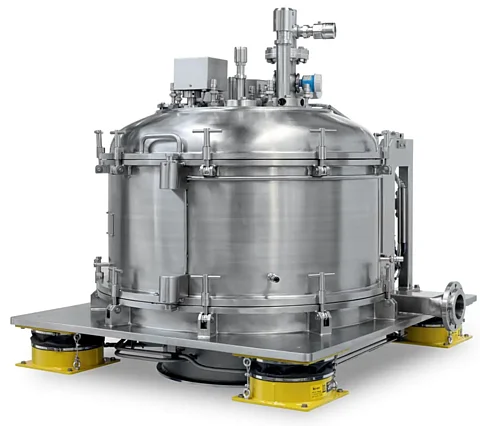
Peeling centrifuge
On the left you can see an example of a centrifuge from the manufacturer Ferrum Process. A peeling centrifuge is a solid-liquid separation device that can be operated both continuously and discontinuously. Within it, solids are separated from a liquid by centrifugal force. During this process, the solid deposits on the inner wall of a rotating drum. The dewatered solid is then mechanically scraped off using a peeling blade and discharged. The centrifugal acceleration acting on the solids can be approximated by
az = ω² · r
where ω is the angular velocity and r is the drum radius. In practice, the relative centrifugal force (RCF) is frequently used, which indicates a multiple of gravitational acceleration.
Peeling centrifuges are primarily used in process engineering for the dewatering and separation of crystalline or particulate solids, for example in the chemical, pharmaceutical or food industries. They enable high separation efficiency, defined residual moisture levels and controlled solids discharge.
The performance of a decanter centrifuge is determined by the drum speed, the decanter technology, the product behaviour, and the feed and discharge conditions. Following mechanical dewatering, the solids are often thermally dried in amixon® vacuum contact dryers.