

hydroxyethyl cellulose
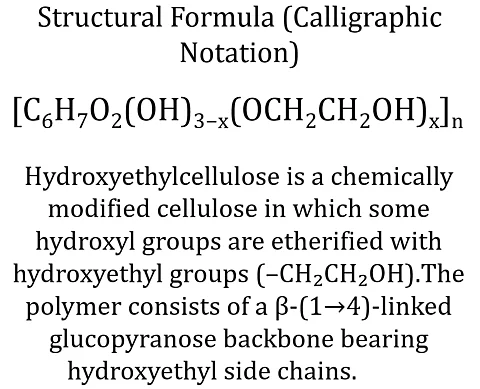
Hydroxyethylcellulose (HEC) is a chemically modified derivative of cellulose. In this, part of the hydroxyl groups of cellulose are etherified with hydroxyethyl groups −CH₂CH₂OH. The structure can be simplified as a cellulose backbone with side groups −O−CH2−CH2−OH−O−CH2−CH2−OH.
Hydroxyethylcellulose occurs as a white to yellowish-white, odorless powder or granulate. It is soluble in cold and warm water and forms colloidal, clear to slightly opalescent solutions. In many organic solvents such as acetone or ethanol, however, HEC is not soluble.
For production, cellulose is first alkalized. The alkali cellulose then reacts with ethylene oxide. In the process, hydroxyethyl groups are formed on the hydroxyl functions of the glucose units. Since the reaction does not go to completion, products with different degrees of substitution are formed.
Important metrics are the average degree of substitution (DS) and the molar degree of substitution (MS). Commercial hydroxyethylcelluloses typically have DS values in the range of 0.85 to 1.35 and MS values of about 1.5 to 3. These parameters influence solubility, viscosity, and gel formation.
HEC has thickening, gelling, and stabilizing effects. It increases the viscosity of aqueous systems and improves the suspendability of solids. In cosmetic formulations, HEC functions as a film former, emulsion stabilizer, and binder. In pharmaceuticals, hydroxyethylcellulose serves as a gelling agent, thickener, and excipient for liquid and semi-solid dosage forms.