
Closure fitting
A shut-off valve is a component that allows a material flow to be released or interrupted in a controlled manner. It is used in pipelines, equipment, and discharge areas. The essential feature of these valves is that they are actuated mechanically, pneumatically, or electrically without the operator coming into contact with the process medium. This increases safety, hygiene, and process control.
In bulk solids and process engineering, shut-off valves are often located at the outlet of silos, mixers, or reactors. They prevent uncontrolled discharge and enable defined emptying or dosing processes. Their design must be matched to the respective product in order to avoid bridging, crushing, or material build-up.
Shut-off valves influence flow behavior, emptying, and hygiene. Dead-space-free geometries are particularly important to avoid product residues. They enable complete emptying and efficient cleaning. In sensitive applications, they help prevent contamination and cross-contamination.
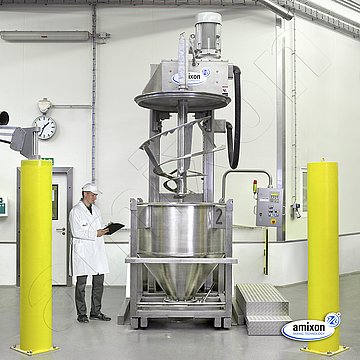
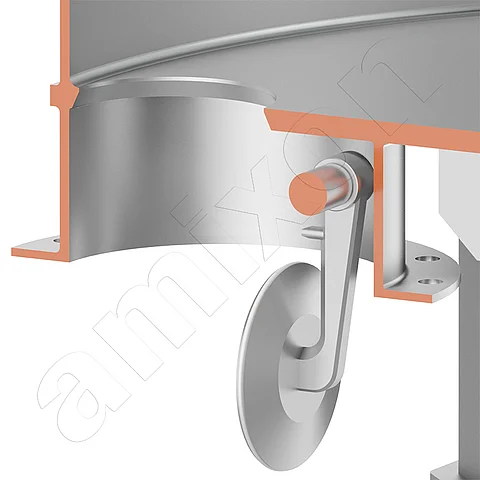
At amixon, shut-off valves are designed so that they can be integrated into the process space without contours. They support dead-space-free apparatus geometries and enable safe process control, even under vacuum or overpressure. The valve is actuated entirely from the outside and remains separated from the product.
Depending on the application, different designs are used, such as flaps, slides, valves, or specially developed bulk solids closures. At amixon® specially developed shut-off and dosing valves such as the DosiFlap® are also used. It combines the function of a shut-off valve with a dosing effect. The DosiFlap enables controlled, reproducible product discharge and can be actuated entirely from the outside. This keeps the operator separated from the medium and the process hygienic and safe. The low-dead-space geometry supports complete emptying and reduces the risk of product build-up and cross-contamination.
 Blog
Blog