

Activation energy
The activation energy is the amount of energy that a system must absorb at minimum for a reaction or a process to get underway. One often speaks of an energy barrier that lies between the initial state and a reactive transition state.
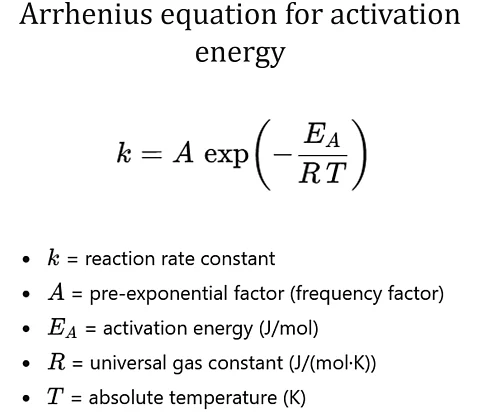
K = A · exp (−EA / (RT))
- k: rate constant
- A: pre-exponential factor (collision frequency factor)
- EA: activation energy
- R: universal gas constant
- T: absolute temperature
If the activation energy is high, the process proceeds slowly or practically not at all at a given temperature. If it is low, the process already sets in markedly under moderate conditions. Temperature has a strong influence: As temperature increases, more particles have sufficient energy available to overcome the barrier, and the process accelerates. Mathematically, this relationship is often described with the Arrhenius equation, in which the reaction rate increases strongly with increasing temperature.