

Infant Formula Mixers: Precision Without Product Loss
amixon® highlights the unique challenges of infant formula mixing—achieving precise distribution of microcomponents while preserving delicate spray-dried agglomerates and protecting heat- and shear-sensitive ingredients—positioning mixing as a critical quality-control step. It introduces three scalable systems: the HM vertical twin-shaft mixer for large batches with rapid, low-shear 3D homogeneity; KoneSlid® mixers for fast, quasi-continuous end-of-line blending with complete discharge; and the AMK continuous mixer that ensures uniformity from startup by synchronizing dosing before opening discharge. The systems feature a comprehensive hygiene concept, including WaterDragon® automated wet cleaning, OmgaSeal® dead-space-free seals, inerting options, and ATEX II 1D certification, and customers can validate performance and scale-up at the amixon® Technical Center.


How can sensitive nutrients be distributed evenly without breaking up agglomerates? amixon® presents three scalable mixing systems for maximum quality in dairy and infant formula production.
amixon® is a German manufacturer of industrial mixers that specializes in the processing of milk powder, dairy products, and infant formula. amixon® mixing systems are used worldwide by manufacturers and contract manufacturers who demand the highest standards of homogeneity, hygiene, and process reliability.
Why Infant Formula Mixing Processes Are Particularly Challenging
No other food product places such high demands on mixing technology as infant formula. Infant Formula is a highly complex powder system: In addition to the milk base, vitamins, minerals, and trace elements such as zinc, copper, selenium, and chromium must be evenly distributed in precisely defined amounts. Added to this are functional ingredients such as encapsulated omega-3 fatty acids, probiotics (e.g., lactobacilli, bifidobacteria), and prebiotics—all of which are sensitive to mechanical and thermal stress.
Another problem: Some vitamins are degraded by the high temperatures in the spray tower and must be added to the powder afterward. The mixing process is therefore not merely a production step, but a critical quality control step that directly determines the nutritional profile of each batch.
The central dilemma for manufacturers is this: mixing precisely without causing damage. The delicate agglomerates from the spray tower must retain their instant properties—dust-free, rapidly soluble, and easily wettable—while ensuring uniform distribution of all microcomponents. Conventional mixers fail precisely because of this conflicting objective.
No other food product places such high demands on mixing technology as infant formula. Infant Formula is a highly complex powder system: In addition to the milk base, vitamins, minerals, and trace elements such as zinc, copper, selenium, and chromium must be evenly distributed in precisely defined amounts. Added to this are functional ingredients such as encapsulated omega-3 fatty acids, probiotics (e.g., lactobacilli, bifidobacteria), and prebiotics—all of which are sensitive to mechanical and thermal stress.
Another problem: Some vitamins are degraded by the high temperatures in the spray tower and must be added to the powder afterward. The mixing process is therefore not merely a production step, but a critical quality control step that directly determines the nutritional profile of each batch.
The central dilemma for manufacturers is this: mixing precisely without causing damage. The delicate agglomerates from the spray tower must retain their instant properties—dust-free, rapidly soluble, and easily wettable—while ensuring uniform distribution of all microcomponents. Conventional mixers fail precisely because of this conflicting objective.
Three amixon® mixing systems for dairy and infant formula production
For the industrial production of milk powder and infant formula, amixon® supplies mixing systems that scale from small batches to large-scale production. Depending on the production strategy and batch volume, three coordinated technologies are available.
1. Large-batch mixing: HM vertical twin-shaft mixer
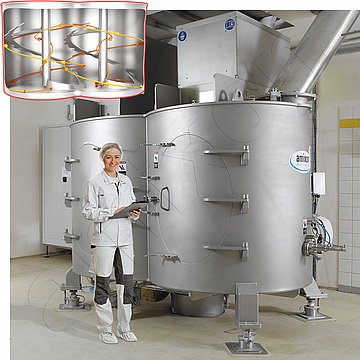
The amixon® HM twin-shaft mixer is suitable for batch volumes up to 12 m³ and production rates of up to 10 metric tons per hour. Its mixing tools rotate at low peripheral speeds of 0.5 to 2 m/s yet still generate a three-dimensional flow that encompasses the entire batch volume. A technically ideal mixing quality (ideal random distribution) is achieved after just 20 to 90 revolutions—even at very low fill levels starting at approximately 10–15% of the usable volume. A single representative sample per batch is sufficient: validated, documentable, and auditable.
2. Quasi-continuous mixing: KoneSlid® mixers (KS)
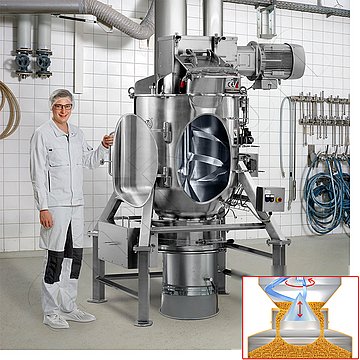
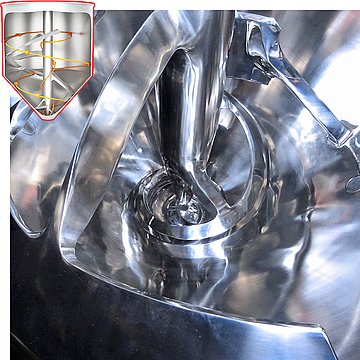
The amixon® KoneSlid® mixer is the solution for end-of-line processes directly before the packaging machine. Two KS mixers operate alternately at a high cycle rate—the entire mixing process, including complete emptying, takes only 120 to 180 seconds for batch sizes ranging from 300 to 1,200 kg. The mixer discharges completely without leaving any product residue. For contract manufacturers who produce in campaigns—kosher, halal, low-allergen, organic—multiple KS lines of identical design are an economically and hygienically compelling solution.
3. Continuous Mixing: AMK
The amixon® AMK continuous mixer solves a typical problem with continuous mixers: During the startup phase, conventional systems operate erratically and produce batches of inferior quality. The AMK remains closed until all dosing systems are fully synchronized—only then does the discharge valve open. The result: From the first to the last kilogram, the mixture remains perfectly homogeneous. Ideal for manufacturers who consistently process large quantities over long production periods.
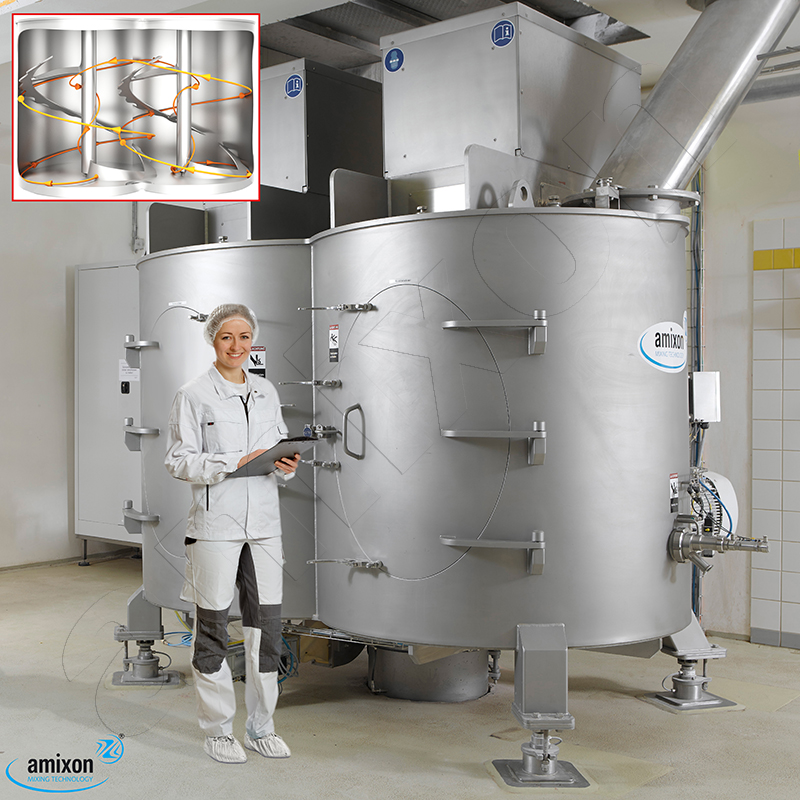
amixon® twin-shaft mixer for large batches

amixon® KoneSlid® mixers achieve ideal mixing quality
For the industrial production of milk powder and infant formula, amixon® supplies mixing systems that scale from small batches to large-scale production. Depending on the production strategy and batch volume, three coordinated technologies are available.
1. Large-batch mixing: HM vertical twin-shaft mixer
The amixon® HM twin-shaft mixer is suitable for batch volumes up to 12 m³ and production rates of up to 10 metric tons per hour. Its mixing tools rotate at low peripheral speeds of 0.5 to 2 m/s yet still generate a three-dimensional flow that encompasses the entire batch volume. A technically ideal mixing quality (ideal random distribution) is achieved after just 20 to 90 revolutions—even at very low fill levels starting at approximately 10–15% of the usable volume. A single representative sample per batch is sufficient: validated, documentable, and auditable.
2. Quasi-continuous mixing: KoneSlid® mixers (KS)
The amixon® KoneSlid® mixer is the solution for end-of-line processes directly before the packaging machine. Two KS mixers operate alternately at a high cycle rate—the entire mixing process, including complete emptying, takes only 120 to 180 seconds for batch sizes ranging from 300 to 1,200 kg. The mixer discharges completely without leaving any product residue. For contract manufacturers who produce in campaigns—kosher, halal, low-allergen, organic—multiple KS lines of identical design are an economically and hygienically compelling solution.
3. Continuous Mixing: AMK
The amixon® AMK continuous mixer solves a typical problem with continuous mixers: During the startup phase, conventional systems operate erratically and produce batches of inferior quality. The AMK remains closed until all dosing systems are fully synchronized—only then does the discharge valve open. The result: From the first to the last kilogram, the mixture remains perfectly homogeneous. Ideal for manufacturers who consistently process large quantities over long production periods.
amixon® twin-shaft mixer for large batches
amixon® KoneSlid® mixers achieve ideal mixing quality
Hygiene as a systemic responsibility—not as an optional extra
In infant formula production, purity is not merely a quality characteristic but a regulatory requirement. amixon® has developed a comprehensive hygiene concept for this purpose that covers all surfaces and interfaces that come into contact with the product:
- WaterDragon® – a fully automatic wet cleaning system that cleans all interior surfaces without leaving any residue and then dries them
- OmgaSeal® – Seals on inspection doors close off the mixing chamber with no dead space, making it gas-tight and dust-tight
- Inerting – The mixing chamber can be evacuated and flushed with nitrogen or CO₂ prior to filling to protect oxidation-sensitive ingredients such as probiotics and omega-3 fatty acids
- ATEX certification – all relevant mixers are certified for dust-explosive materials in accordance with ATEX II 1D (Zone 20)
In infant formula production, purity is not merely a quality characteristic but a regulatory requirement. amixon® has developed a comprehensive hygiene concept for this purpose that covers all surfaces and interfaces that come into contact with the product:
- WaterDragon® – a fully automatic wet cleaning system that cleans all interior surfaces without leaving any residue and then dries them
- OmgaSeal® – Seals on inspection doors close off the mixing chamber with no dead space, making it gas-tight and dust-tight
- Inerting – The mixing chamber can be evacuated and flushed with nitrogen or CO₂ prior to filling to protect oxidation-sensitive ingredients such as probiotics and omega-3 fatty acids
- ATEX certification – all relevant mixers are certified for dust-explosive materials in accordance with ATEX II 1D (Zone 20)
FAQ: Frequently Asked Questions About Mixing Systems for Dairy, Milk Powder, and Infant Formula
Which mixers are suitable for the production of infant formula?
Vertical mixers that operate particularly gently and at low peripheral speeds are particularly well-suited for infant formula. amixon® offers the HM twin-shaft mixer for large batches, the KoneSlid® for quasi-continuous end-of-line processes, and the AMK for continuous, long-term operation.
How are microcomponents such as vitamins and trace elements homogeneously distributed in milk powder?
Since many microcomponents do not survive the spray-drying process, they are added to the powder afterward and incorporated in a separate mixing process. A three-dimensional mixing flow is crucial here, as it distributes even the smallest quantities evenly throughout the entire batch volume—as generated by the amixon® HM.
Why is hygiene particularly critical when mixing infant formula?
Infants do not yet have a fully developed immune system. Even the smallest amount of contamination can be life-threatening. Mixing systems for infant formula must therefore be free of dead spaces, capable of being completely emptied of residue, and fully washable with water—requirements that amixon® mixers with WaterDragon® and OmgaSeal® meet.
What is the difference between batch and continuous mixing for milk powder?
In batch mixing, a defined quantity is thoroughly mixed, validated, and then discharged—ideal for quality documentation and batch traceability. In continuous mixing (AMK), the product flows continuously through the mixer—economical for large volumes, provided that the start-up behavior is controlled, which amixon® achieves through the delayed opening of the discharge valve.
What must an industrial mixer for infant formula be capable of?
It must handle sensitive agglomerates gently, distribute microcomponents precisely, be fully drainable and cleanable in accordance with hygiene standards, meet ATEX requirements, and be scalable to handle batch sizes ranging from a few hundred to several thousand kilograms. amixon® mixers meet all of these requirements.
Learn more about the benefits of amixon® mixing technology for dairy, milk powder, and infant formula in our fact sheet!
Which mixers are suitable for the production of infant formula?
Vertical mixers that operate particularly gently and at low peripheral speeds are particularly well-suited for infant formula. amixon® offers the HM twin-shaft mixer for large batches, the KoneSlid® for quasi-continuous end-of-line processes, and the AMK for continuous, long-term operation.
How are microcomponents such as vitamins and trace elements homogeneously distributed in milk powder?
Since many microcomponents do not survive the spray-drying process, they are added to the powder afterward and incorporated in a separate mixing process. A three-dimensional mixing flow is crucial here, as it distributes even the smallest quantities evenly throughout the entire batch volume—as generated by the amixon® HM.
Why is hygiene particularly critical when mixing infant formula?
Infants do not yet have a fully developed immune system. Even the smallest amount of contamination can be life-threatening. Mixing systems for infant formula must therefore be free of dead spaces, capable of being completely emptied of residue, and fully washable with water—requirements that amixon® mixers with WaterDragon® and OmgaSeal® meet.
What is the difference between batch and continuous mixing for milk powder?
In batch mixing, a defined quantity is thoroughly mixed, validated, and then discharged—ideal for quality documentation and batch traceability. In continuous mixing (AMK), the product flows continuously through the mixer—economical for large volumes, provided that the start-up behavior is controlled, which amixon® achieves through the delayed opening of the discharge valve.
What must an industrial mixer for infant formula be capable of?
It must handle sensitive agglomerates gently, distribute microcomponents precisely, be fully drainable and cleanable in accordance with hygiene standards, meet ATEX requirements, and be scalable to handle batch sizes ranging from a few hundred to several thousand kilograms. amixon® mixers meet all of these requirements.
Learn more about the benefits of amixon® mixing technology for dairy, milk powder, and infant formula in our fact sheet!
Process Validation at the amixon® Technical Center
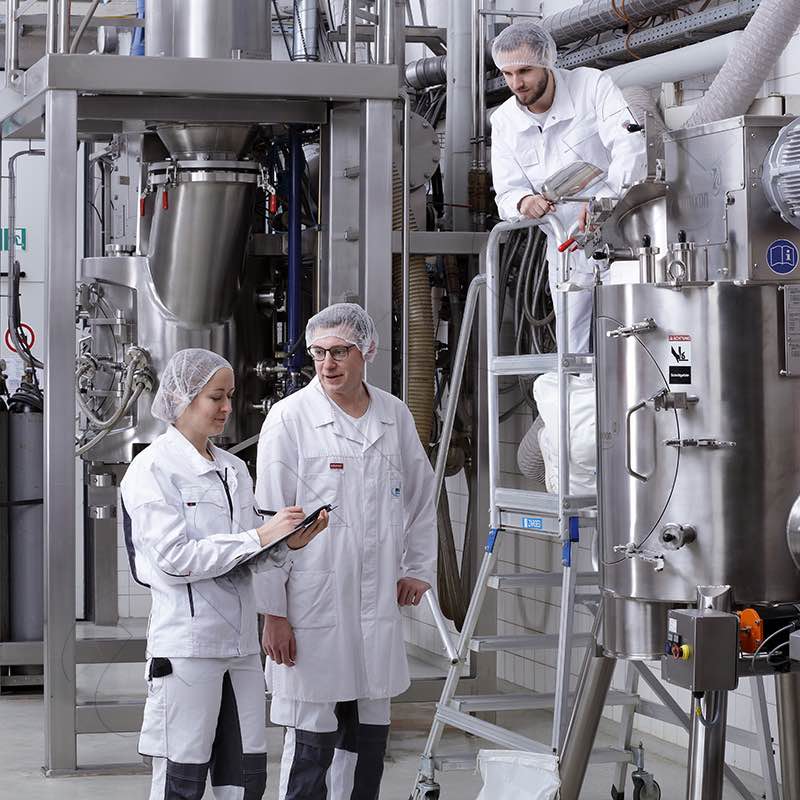
amixon® test center
Customers have the opportunity to test their original products in advance on our mixing systems under real-world conditions at the amixon® Technical Center. This allows for the practical validation of mixing behavior, distribution accuracy, and scale-up—providing a solid basis for decision-making that ensures maximum investment security before purchasing the machine.
amixon® test center
Customers have the opportunity to test their original products in advance on our mixing systems under real-world conditions at the amixon® Technical Center. This allows for the practical validation of mixing behavior, distribution accuracy, and scale-up—providing a solid basis for decision-making that ensures maximum investment security before purchasing the machine.
 Related News
© Copyright by amixon GmbH