

Vacuum Conveying
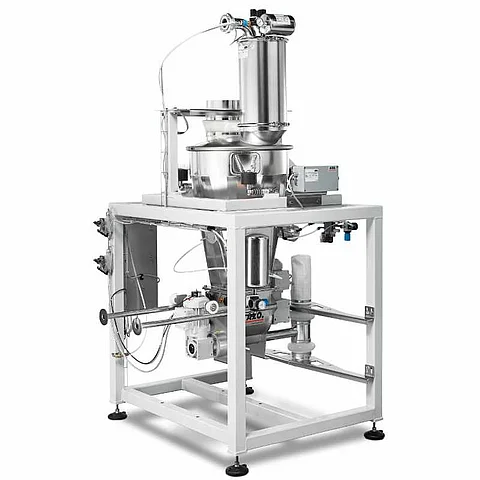
The image on the left shows an AZO receiver for bulk solids. It is installed above a loss-in-weight feeder. Vacuum conveying refers to the use of negative pressure (vacuum) to transport products and components. The vacuum is typically generated by Venturi ejectors, liquid ring vacuum pumps, rotary vane vacuum pumps, screw vacuum pumps, or central steam ejectors.
In process engineering, vacuum conveying is used for applications such as the pneumatic transport of powders and granules, dust extraction, and material processing. It enables the enclosed, dust-free transport of bulk solids with minimal contact. This can improve process safety and occupational hygiene.
The conveying direction is determined exclusively by the pressure differential. In addition to vacuum conveying, there are also positive-pressure pneumatic conveying systems. Positive-pressure systems can transport material from a single feed station to multiple receiving points, each equipped with a receiver. In vacuum conveying systems, however, the arrangement is often reversed: there is one central receiving point and multiple feed stations.
Powder mixers can serve as receivers, provided they are designed to withstand vacuum or pressure and are sufficiently airtight. amixon® mixers can also be used as vacuum receivers for feeding bulk solids. For larger batch mixers, certification of adequate vacuum resistance is required.