

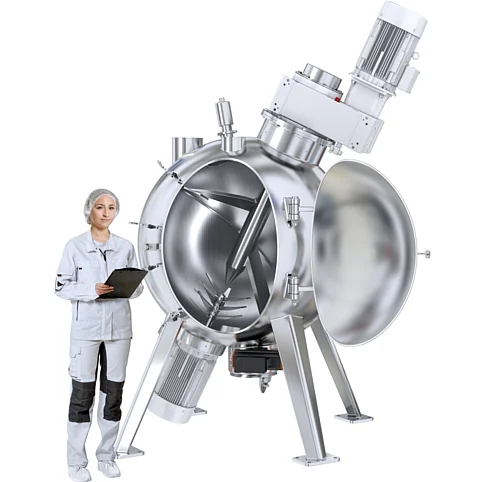
Sanitary design
Sanitary design (also known as hygienic design) refers to the structural design of apparatus, machinery and systems that enables simple, thorough and safe cleaning. In this context, surfaces, geometries, seals, contour transitions and materials are designed in such a way as to prevent product adhesion, dead spaces and microbiological contamination.
In process engineering, sanitary design is of particular importance in hygiene-sensitive sectors, such as the food, pharmaceutical and chemical industries. Smooth surfaces, designs with minimal dead spaces, defined surface roughness, easily accessible components, as well as suitable materials and sealing concepts help to reduce the cleaning effort and ensure reproducible hygiene standards.
Sanitary design versus hygienic design
Although the terms are sometimes used interchangeably, sanitary design is not the same as hygienic design. Hygienic design is a clearly defined, engineering-based design principle. It ensures that systems can be operated without contamination and cleaned completely and reproducibly. This includes dead-space-free geometries, complete drainability, suitable materials, defined surface roughness, and CIP and SIP capability. Hygienic Design is underpinned by standards, such as those set by the EHEDG or the 3-A Sanitary Standards. It plays a central role in the pharmaceutical, food and cosmetics industries.
The term “sanitary design”, on the other hand, is not clearly defined. In German-speaking countries, it is often used in a vague sense. It usually refers to a design that is easy to clean or suitable for food contact, for example using stainless steel and smooth surfaces. However, this does not automatically imply a normative basis or validatable cleanability.