Particle diameter
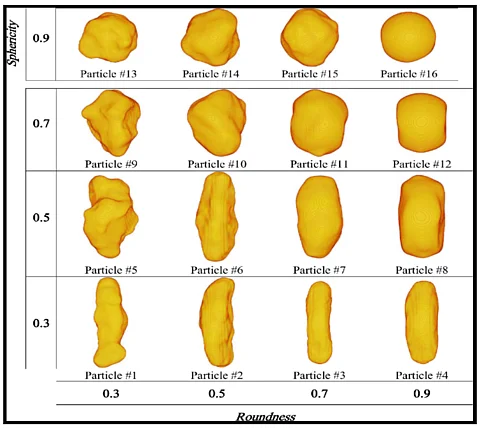
The term ‘particle diameter’ describes the characteristic size of individual particles in a bulk material. In practice, however, it is difficult to determine this size precisely, as particles are not usually spherical. Instead, they usually have irregular, often complex geometries. It is therefore necessary to consider the dimensions in three dimensions: length, width and height.
In process engineering, simplified models are used to enable a uniform description. The equivalent sphere diameter is a frequently used parameter. It indicates the diameter of a sphere that has the same volume, surface area or aerodynamic behaviour as the real particle.
The particle diameter can be measured in various ways. A classic method is sieve analysis. In this process, the bulk material is separated using sieves with defined mesh sizes. The particle size distribution can be derived from the retained mass fractions. This method is robust and widely used, but it can alter the powder itself, for example through abrasion or the breakage of sensitive agglomerates.
In addition to sieving, modern optical measurement methods have become established. These include laser diffraction, image analysis and scattered light measurement. These methods can measure particle sizes without contact and with high precision. Some systems are capable of performing measurements inline, i.e. directly during the product flow in the process line. This allows changes in the particle collective to be monitored in real time.
Irregular particles, such as agglomerates of instant coffee or instant meals, pose a particular challenge. They are often porous, irregularly shaped and mechanically sensitive. Even slight stresses can change their structure and thus influence the measurement result.
Powder mixers can perform several tasks during the mixing process: They can deagglomerate agglomerates. They can round particles and attach dusty particles to larger particles (aggregate). They can also coat particles. In addition, they can wet or dry particles very evenly. amixon® manufactures a wide range of precision mixers for precisely such processing tasks.
 Blog
Blog