
Nanodisperse liquid
A nanodisperse liquid is a heterogeneous system in which solid particles with characteristic dimensions in the nanometre range are finely distributed in a continuous liquid phase. Ideally, the particles are present as individual primary particles. In this case, we refer to an agglomerate-free nanodispersion. The production of nanodisperse liquids is energetically and process-technologically demanding. Nanoparticles have a very high specific surface area and thus a high free surface energy. This leads to strong interparticle attractive forces, in particular Van der Waals forces. These forces promote agglomeration and must be completely overcome during the dispersion process.
The required deagglomeration energy is directly related to the new surface area to be created. The minimum energy required can be approximated using the surface energy:
E ≈ γ · ΔA
Here, γ is the specific surface energy of the solid and ΔA is the new surface area created when the agglomerates are broken up. Since ΔA increases sharply as particle size decreases, the energy requirement for nanodisperse systems increases disproportionately.
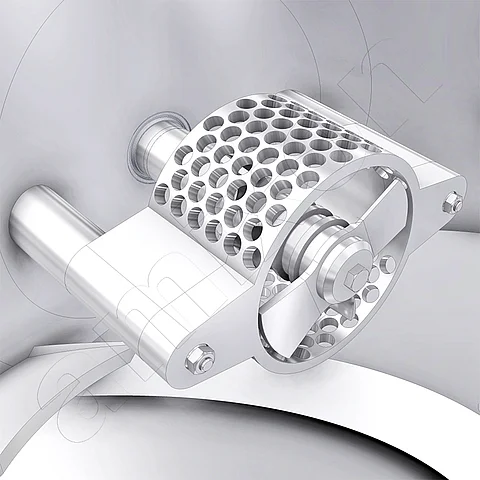
In real processes, the locally applied mechanical energy must be greater than the binding energy of the agglomerates. The decisive factor here is not only the total energy, but also the power and energy density in the dispersion chamber. Effective deagglomeration requires high local shear rates, impact energies or pressure-induced stresses, such as those occurring in high-shear, grinding or cavitation equipment.
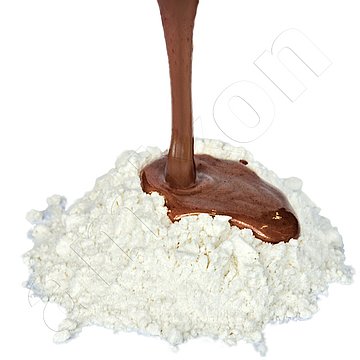
Ambient air is a significant disturbance factor when dispersing nanodisperse powders in liquids. When powder is introduced, air is entrained, which creates additional interfaces as a gas phase. Nanoparticles preferentially adsorb at gas-liquid interfaces because this is energetically favourable. This promotes the formation of stable agglomerates and hinders the complete wetting of the particles. The effect is particularly pronounced in highly viscous liquids, as trapped air bubbles escape only slowly and effective shear transfer is reduced locally.
In addition to deagglomeration, the stability of the dispersion is crucial. Nanodisperse liquids are thermodynamically unstable but can be kinetically stabilised. Without stabilisation, nanoparticles tend to re-agglomerate due to their high surface energy. Stability is typically described by electrostatic repulsion, for example in the context of DLVO theory, or by steric hindrance using polymeric or molecular additives.
The sedimentation of nanodisperse particles is greatly reduced. The sinking velocity approximately follows Stokes' law and is proportional to the square of the particle diameter. For nanoparticles, sedimentation is often superimposed or completely compensated by Brownian motion. In many cases, nanodisperse liquids are therefore sedimentation-stable over long periods of time as long as no agglomeration occurs.
 Blog
Blog