

Flow point and yield point
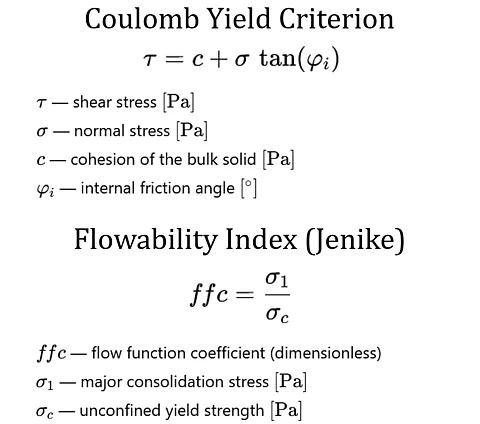
The flow point is a single point on the flow limit. It describes the specific stress state (σ, τ) at which the bulk material fails in the shear test and begins to flow. A series of flow points for different pre-compactions results in the flow curve or flow limit of the material. For many applications, the flow limit is approximately described by a Coulomb straight line.
τ=c + σ · tan(φ_i)
- τ: shear stress
- σ: Normal stress
- c: Cohesion of the bulk material
- φ_i: internal friction angle
For free-flowing, non-cohesive bulk solids, c = 0 is often set. This simplifies the relationship to:
τ = σ · tan(φ_i)
- Flow function and flow factor ff
Both the yield point and the flow function are derived from the shear tests. It describes the dependence of the bulk strength σ_c on the consolidation stress σ₁. From this, a dimensionless flow factor f_(fc) is formed.
ffc = σ_1 / σ_c
- ffc: Flowability index
- σ_1: consolidation stress
- σ_c: bulk strength (compressive strength at the point of flow)
Typical qualitative classification:
- ffc < 1: not fluent
- 1 < ffc < 2: very cohesive
- 2 < ffc < 4: cohesive
- 4 < ff_c < 10: good flow
- ffc ≥ 10: free-flowing.
This index is used, for example, to classify the siloability of a powder.
Effective friction angle φ_e
The effective internal friction angle φ_e can be determined from the yield points, which characterises the slope of the shear line in the σ–τ diagram. A simple relationship is:
tan(φ_e) = τ / σ
- τ: shear stress at the yield point
- σ: Normal stress at the yield point
The effective internal friction angle φ_e is an important parameter for the design of silo hoppers and discharge devices.