

Encapsulation of propellants
The coating or encapsulation of gas-forming substances with a protective layer is known as propellant coating. This protects the propellant from moisture, oxygen and premature reaction. The coating also enables the controlled release of the propellant during the process.
Encapsulated blowing agents are used in the form of microencapsulated or coated particles. The coating may consist of polymers, waxes, fats, salts or inorganic materials. It is applied by spray coating, fluidised-bed coating, coacervation or melt coating.
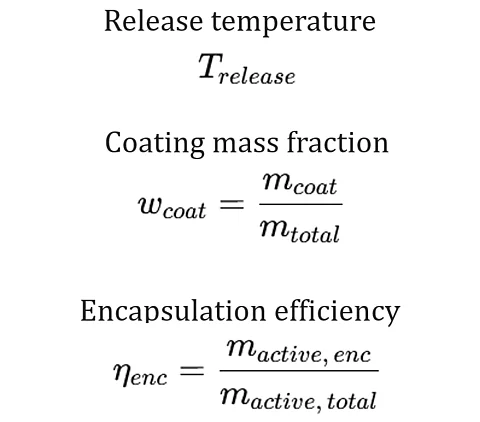
The proportion of the shell layer is often described in terms of mass fraction.
w(coat) = m(coat) / m(total)
- wcoat is the mass fraction of the coating
- mcoat is the mass of the coating layer
- mtotal is the total mass of the coated particle
The effectiveness of encapsulation is described by the encapsulation efficiency
ηenc = mactive,enc / mactive,total
- ηenc is the encapsulation efficiency
- mactive,enc is the encapsulated active propellant compound
- mactive,total is the total mass of propellant used
The release of the propellant is often temperature-dependent. The characteristic release temperature is known as the ‘trelease’; it depends on the properties of the coating material (e.g. melting point or glass transition temperature) and on the thickness of the layer.
Coating improves storage stability, ease of dosing and process reliability, as it reduces uncontrolled gas release, dust explosions and undesirable reactions with other components. In baking mixes, the coating enables temperature- or pH-dependent gas release. This allows volume expansion and pore structure to be precisely controlled. In plastics, it controls the foam structure and pore formation, for example through expanding microspheres.
The encapsulation of propellants is used in the plastics, food, chemical and detergent industries and is a key step in material processing and the production of functionalised particles.
 Related pages