
Abrasion
The terms abrasion, wear and tear are of great importance when bulk materials are mixed or conveyed. Abrasion always occurs in the contact zone when two bodies move relative to one another. In this process, the harder body damages the surface of the softer solid.
Bulk material particles themselves should also be regarded as bodies. They generally have an irregular shape, as well as a minimum and maximum diameter. The finer the material, the greater the specific contact area and thus the potential for wear. Bulk materials can be classified, amongst other things, into microstructured particles in the range of 10⁻⁶ metres and nanostructured particles in the range of 10⁻⁹ metres.
Abrasion increases when the coefficient of friction between the particles is high, the pressure rises, the surface is rough, or the difference in velocity increases. Increased friction due to heating can also exacerbate wear. Furthermore, viscous liquids or abrasive powders between the particles promote wear.
When mixing a bulk material with a rotating agitator, the drive torque is a measure of the internal friction of the bulk material. During the mixing or conveying process, the particles rub not only against each other, but also against the mixing tool and the wall of the mixing chamber. This is precisely where typical wear zones develop.
Wear on the mixing tool and the mixing vessel is undesirable. It can contaminate the material being mixed and simultaneously damage the machine. Therefore, adequate wear protection and a suitable design of the contact surfaces are crucial, particularly for abrasive, fine-grained or hard bulk materials.
Possible countermeasures include:
- Reducing the rotational speed of the mixing tool,
- Shortening the mixing time, provided the mixing system has high mixing efficiency, and
- Reducing the conveying speed.
- Selecting a particularly hard material for the mixer or conveyor.
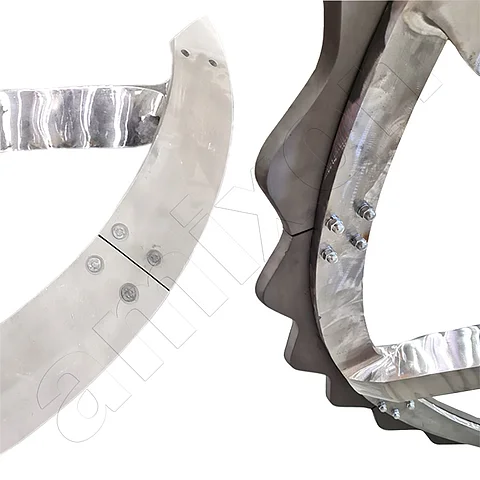
- Reinforcing tool components with carbide welding.
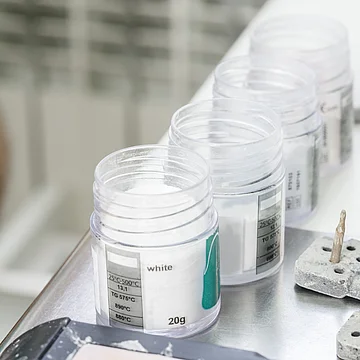
- Selecting suitable coatings, for example made of oxide ceramics
amixon® solutions for abrasive mixing processes
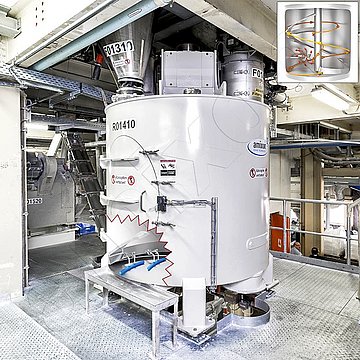
Abrasion occurs wherever hard particles slide under pressure across surfaces – in industrial mixing technology, this is an everyday reality. amixon® has developed proven machine concepts specifically for abrasive bulk materials such as metal powders, hard metals, tungsten carbide, zirconia, and technical ceramics that systematically minimize wear.
Frequently asked questions: amixon® and abrasion
How does amixon® protect mixers from wear caused by abrasive powders?
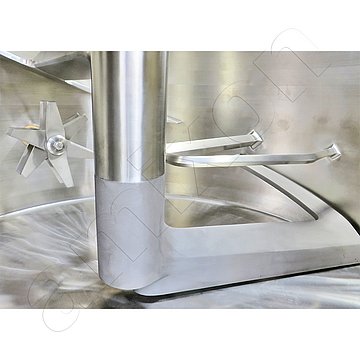
amixon® combines design-based measures (low rotational speed, smooth tool geometry, top-mounted shaft seals) with six applicable wear protection methods – including hard alloy buildup welding and high-performance ceramic coatings.
Which amixon® mixer is suitable for abrasive ceramic powders?
For finest technical ceramics such as zirconia or silicon nitride, the VM mixer in a wear-protected configuration is recommended.
For large batch volumes up to 100 m³, the Gyraton® GM mixer is the first choice.
How long do amixon® mixing tools last with highly abrasive materials?
With appropriate wear protection measures, the service life of mixing tools can be extended many times over – in documented individual cases by a factor of 100 compared to unprotected tools.
Can amixon® process materials that absolutely cannot tolerate metal contamination?
Yes. For applications such as battery masses or electrode materials, all product-contact surfaces can be fully coated with oxide ceramics – direct metal contact with the product is then completely eliminated.
Where can I test amixon® mixers under real-world conditions?
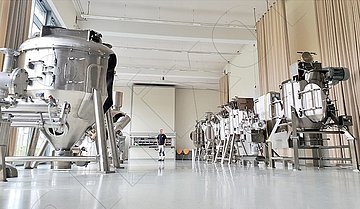
At the amixon® test center in Paderborn, test mixers from all series are available. Trials using original materials with individual configurations are possible.
 FAQ - Abrasion
 Blog
Blog

 Related pages