

Technical school for drying, vacuum, and reaction processes
Security for thermal and reactive applications
Drying and reaction-guided processes place special demands on equipment, process control, and operational safety. Heat transfer, drying speed, product behavior under temperature or vacuum, as well as safety-related effects can only be predicted to a limited extent - they only become apparent under realistic conditions.
In the amixon® Technical Center, these processes are investigated with original products and operated under practical operating conditions. This creates a solid foundation for later investment in an amixon® apparatus.
Request a pilot plant appointment
Evaluate thermal processes realistically
In drying and reaction processes, in addition to the basic feasibility, the crucial question is how stable, uniform, and reproducible the process can be carried out in the intended scale.
In the Technical Center, the following aspects are considered, among others:
- Achievability of defined residual moisture or reaction stages
- Uniformity of the process over the entire product quantity
- Heat transfer at real filling levels and product conditions
- Influence of temperature profiles, vacuum, or pressure on the product
- Changes in structure, dust content, or handling properties
These questions can be systematically examined and documented in the Technical Center - under conditions that are close to actual operation.
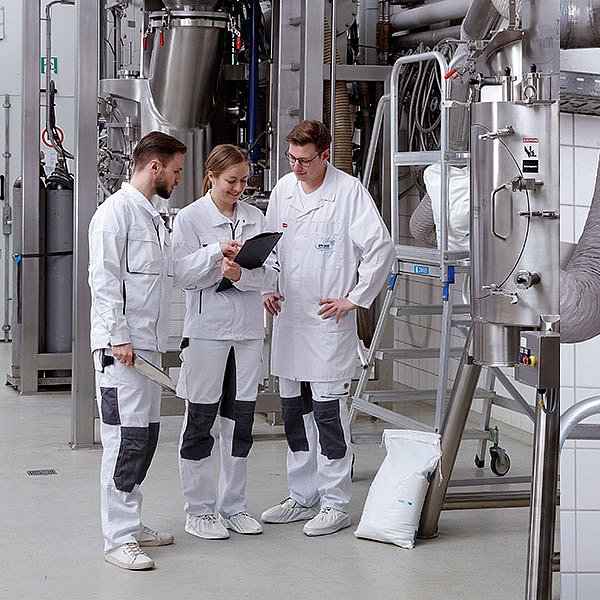
Processes under extended boundary conditions
Many applications require operating conditions beyond the usual. In the amixon® technical center, processes can also be considered where:
- elevated or varying temperatures are used
- working under vacuum or overpressure
- reactive or safety-critical substance systems are present
- high demands on equipment protection and product cleanliness exist
- special materials such as Alloy59 or Hastelloy C22 are required
An integrated safety concept ensures that even such processes can be investigated in a controlled, traceable, and reproducible manner.
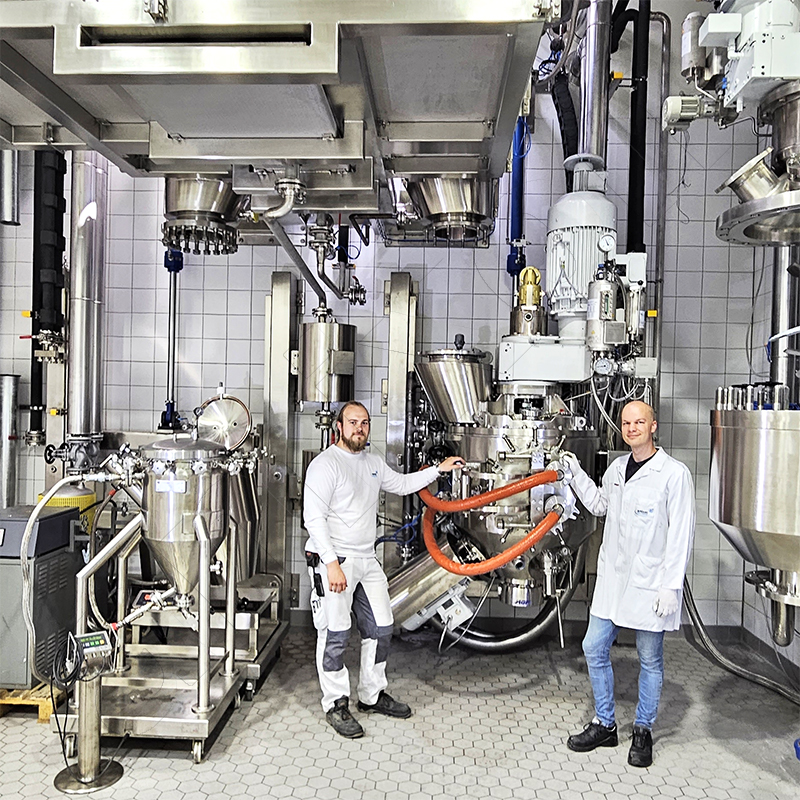
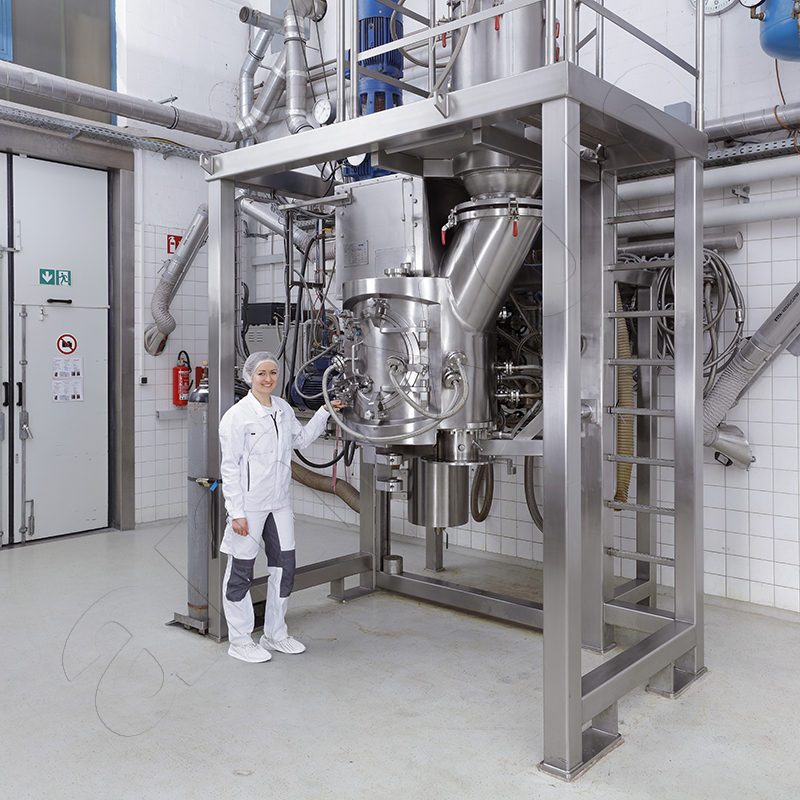
From conducting the experiment to a reliable interpretation
The results obtained in the technical center provide concrete clues for later design. Based on this, it is possible to determine, among other things:
- suitable designs and sizes
- set temperature, pressure, and time parameters
- realistically estimate energy requirements and process duration
- reduce risks to product quality and operational safety
This creates planning security for industrial implementation.
Your benefits at a glance
- Transparency about the behavior of your product under thermal conditions and changing pressures
- Reliable statements about process stability and reproducibility
- Clear foundations for the design of the production plant
- Reduced technical and economic risks
Invitation to Paderborn
Just in the case of thermal and reactive processes, it is worth taking a look at real operation. A pilot plant experiment provides clarity and supports well-founded decisions. We invite you to observe your drying or reaction processes in the amixon® pilot plant under realistic conditions - practical, confidential, and with a focus on industrial implementation.

Drying, vacuum, and reaction processes in the amixon® technical center: In the amixon® technical center, thermal and reactive processes with original products are investigated under realistic operating conditions. The aim is to evaluate process stability, heat transfer, and product behavior, as well as to derive reliable foundations for industrial implementation. The results are reproducible and transferable to the production scale.