

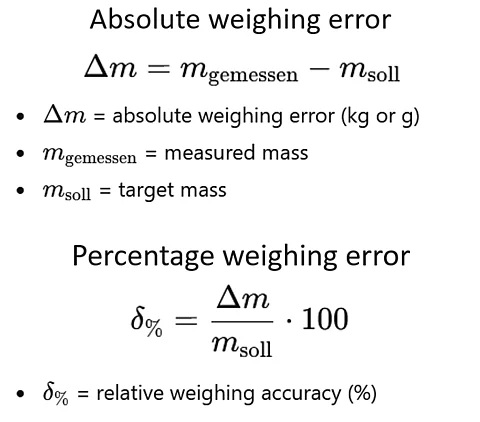
Weighing data
Weighing data are the measured values of a product's mass determined by scales or weighing systems. They arise in static or dynamic weighing operations. Weighing data are recorded continuously or discontinuously and processed electronically.
In process engineering they are used for dosing raw materials, for batch control, and for monitoring mass flows. They are a central source of information for recipe management and process control. Accurate weighing data are the basis for reproducible product quality. Weighing data are often integrated into control and supervisory systems. There they are stored, evaluated, and documented. They enable traceability, balancing, and quality documentation.
In mixing, drying, and reaction processes, weighing data support the monitoring of feeds and discharges. Deviations in weighing are an early indicator of faults. This helps prevent process disturbances. The quality of the weighing data depends on the resolution, accuracy, and stability of the weighing system. Mechanical influences, vibrations, and temperature fluctuations must be taken into account.
 Blog
Blog