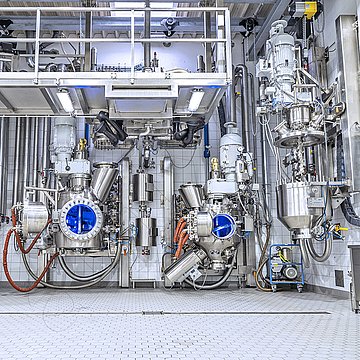
Vacuum still
A vacuum still is a distillation apparatus that operates under vacuum. The pressure in the system is below atmospheric pressure. As a result, the boiling points of the liquids decrease.
In a still, fluids with different boiling points can be separated from each other. The component with the lower boiling point vaporizes first. The vapor is condensed and withdrawn as distillate. Components with higher boiling points remain in the bottoms.
Under vacuum, temperature-sensitive substances can be gently evaporated. Decomposition and oxidation are reduced. Energy efficiency can be improved.
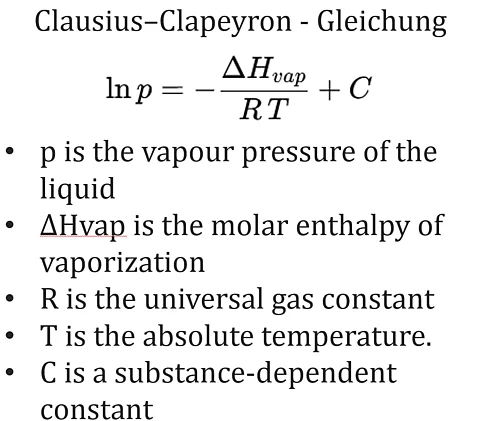
The relationship between pressure and boiling point can be approximated by the integrated Clausius–Clapeyron equation:
ln p = - ΔHvap / (R · T) + C
- p is the vapor pressure of the liquid
- ΔHvap is the molar enthalpy of vaporization
- R is the universal gas constant
- T is the absolute temperature
- C is a substance-dependent constant
The equation shows that the vapor pressure increases with rising temperature and the boiling point decreases with falling pressure.
A vacuum still typically consists of an evaporator, a separation stage or column, a condenser, and a vacuum system. Vacuum pumps and condensers are essential components. Vacuum stills are used in the chemical, pharmaceutical, food, and plastics industries. They are used for purification, concentration, and recovery of solvents and products.
 Blog
Blog