
Vacuum mix drying
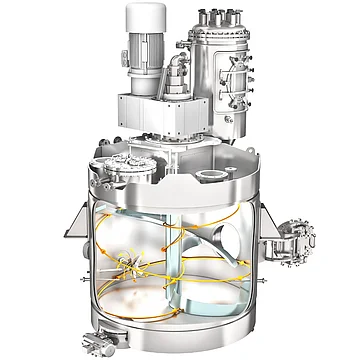
Vacuum mixing and drying is a combined mixing and drying process carried out under vacuum. During this process, the product is continuously agitated whilst being dehydrated. The vacuum causes the boiling point of the liquid to drop, thereby enabling drying at low temperatures.
Mixing ensures uniform heat and mass transfer. Agglomerates are broken up. The surface area is increased. Drying is accelerated.
In vacuum mixing drying, heat transfer occurs through contact between the moist particles and the heated surface of the dryer. Heat is supplied via temperature-controlled vessel walls, heating coils or heated mixing tools. The specific surface area of the dryer is of particular importance in this process. A large heat transfer surface area increases the drying rate and energy efficiency.
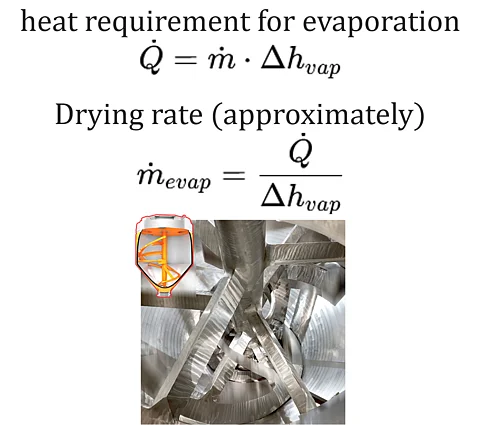
The heat required for evaporation is described by the following equation:
Q˙ = m˙⋅Δhvap
- Q is the heat demand or the heat input
- m˙ is the mass flow rate of the evaporating water or solvent
- Δhvap is the enthalpy of vaporisation of the liquid
The drying rate can be described approximately by
m˙evap = Δhvap · Q˙
- m˙evap is the evaporation flow rate of the liquid
- Q˙ is the rated heat output
- Δhvap: the enthalpy of vaporisation
The vapour is removed via vapour filters, condensers and vacuum pumps. Vacuum mixing drying is used for powders, pastes and suspensions. It plays an important role in the chemical, food, pharmaceutical and battery industries. The process is particularly suitable for temperature-sensitive or oxidation-prone products. Under vacuum, fluids evaporate at much lower temperatures.