

Suspended solids
A suspension is a heterogeneous mixture of solids and a liquid. Suspended solids are solid particles dispersed in a fluid. The particles can be kept in suspension by flow or Brownian motion.
Particle size ranges from a few nanometers to millimeters. In most cases, the solids have a higher density than the liquid. In a state of rest, the following applies: the smaller the particles, the longer they can remain in suspension. They sediment only slowly. In contrast, larger particles sediment faster. The solid concentration influences the viscosity, density, as well as heat and mass transfer.
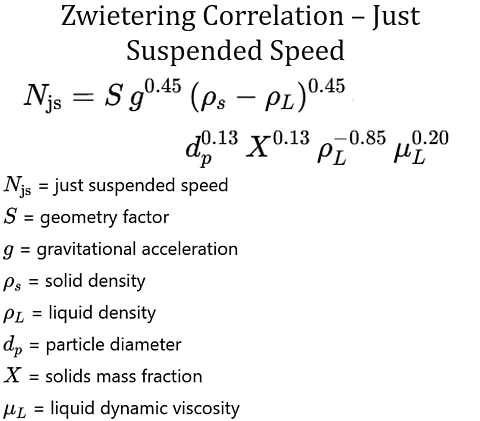
For "solids in suspended form," correlation equations are frequently used in mixing technology, e.g., for the minimum speed for complete suspension or for the solid concentration. A central approach is the Zwietering correlation for the minimum speed of the mixing tool. In this state, no particles remain on the bottom.
N_js = S · g^0.45 · (ρ_s −ρ_L)^0.45 · d_p^0.13 · X^0.13 ·ρ_L^−0.85 ·μ_L^0.20
- N_js = minimum speed for complete suspension (s⁻¹ or min⁻¹)
- S = empirical geometry factor (depending on impeller type, vessel, internals)
- g = gravitational acceleration
- ρ_s = density of the solid particles
- ρ_L = density of the liquid
- d_p = particle diameter
- X = solid mass fraction (or volume fraction, depending on the correlation form)
- μ_L = dynamic viscosity of the liquid
Effective density of the suspension:
ρ_mix = (1 − φ_s) · ρ_L + φ_s · ρ_s
- φ_s = solid volume fraction
Effective viscosity of highly concentrated suspensions (example approach):
η_eff = η_L · (1 − φ_s / φ_max)^−[α]
- η_eff: effective (apparent) viscosity of the suspension
- η_L: viscosity of the liquid phase (pure fluid without solids)
- φ_s: volume fraction of the solid particles in the suspension (0…1)
- φ_max: maximum packing solid volume fraction (at which the system "clogs" or becomes highly pasty; depending on particle shape and distribution)
- α: empirical exponent (dimensionless) describing how strongly the viscosity increases with increasing φ_s; typically determined based on a fit of measurement data
Suspended solids occur in chemical, food, pharmaceutical, and environmental engineering. Examples include slurries, crystal suspensions, sunscreen, pigment dispersions, and wastewater.