

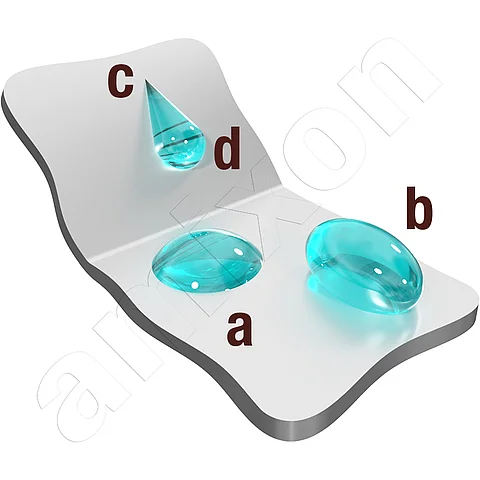
Surface finish
Surface finish describes the surface quality of metallic or coated components in process equipment. It is achieved through mechanical machining processes such as grinding or polishing and is quantified using surface roughness parameters (e.g. Ra, Rz or Rq). Surface finish influences friction, adhesion, cleanability and the wear behaviour of surfaces.
Ra = (1/L) ∫_0^L |z(x)| dx
- Ra is the mean value of the absolute values of the profile deviations from the centre line over the measurement length L.
Rq = sqrt( (1/L) ∫_0^L (z(x))^2 dx )
- Rq is the square root of the mean square deviation of the profile (RMS value).
Rz = (1/5) Σ_(i=1)^5 Rz_i
Averaged roughness depth Rz (classical 5-section definition). The measurement section is divided into five individual sections of equal length. In each section, the profile height Rz_i is determined as the distance between the highest peak and the lowest valley. Rz is the arithmetic mean of these five values.
In process engineering, the surface finish of surfaces in contact with the product is important and is usually specified in Ra. Smooth surfaces with low roughness reduce product adhesion, dead spaces and the risk of cross-contamination. They facilitate cleaning, improve residual discharge and contribute to the hygienic design of equipment, which is particularly important in the food, pharmaceutical and fine chemicals industries.
Depending on the abrasiveness of the powders, it often happens that the bulk materials polish the surfaces of process equipment themselves, causing certain parts of the surfaces in contact with the product to become partially mirror-smooth.