

Segregation
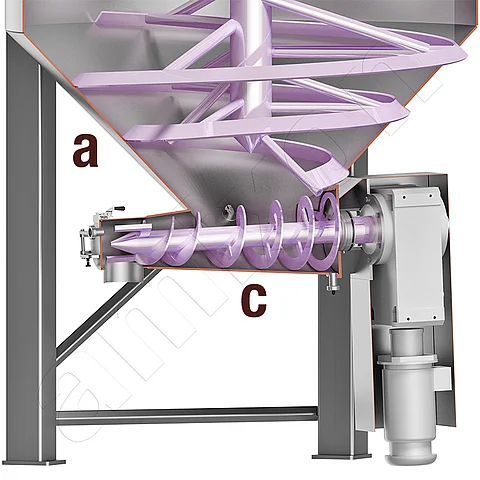
amixon® fermenter: The image shows how bulk materials are discharged and conveyed without segregation occurring. Segregation refers to the process of separation of powders, granulates or bulk materials, in which the particles separate spatially due to differing properties. Causes of this include differences in particle size, density, shape, surface texture or flow behaviour.
Segregation typically occurs during pouring, filling of silos, conveying or dosing, as well as due to vibrations. Common mechanisms include the percolation of small particles through coarse layers, density segregation, inertia segregation and segregation due to different angles of repose.
In process engineering, segregation is regarded as an undesirable effect, as it impairs the homogeneity of mixtures and can lead to fluctuations in quality. Preventing segregation is therefore an important objective in the design of mixers, conveying systems and storage vessels.