
Rheology
Rheology describes the relationships between mechanical stress and the time-dependent deformation or flow behaviour of matter. It accounts for non-linear, shear-rate- and structure-dependent effects, and thus forms the theoretical basis for describing real material systems that go beyond idealised models of solids and liquids.
Rheology is the science of the flow and deformation behaviour of materials under mechanical stress. It describes how materials react to shear, pressure, tension or time-dependent loads, thereby bridging the boundaries between solid mechanics and fluid mechanics.
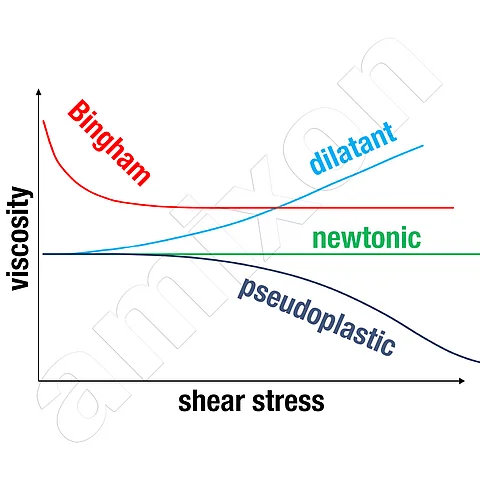
At the heart of rheology lies the relationship between applied stress and the resulting deformation or flow rate. Depending on the material’s structure, composition and stress, substances may react in a solid-like, liquid-like or viscoelastic manner. This behaviour is often non-linear, shear-rate-dependent and time-dependent.
Rheology is applied to liquids, pastes, suspensions, polymers and bulk materials. In these, rheological effects manifest themselves through yield points, cohesion, internal friction and compaction behaviour. It thus provides the theoretical basis for understanding and designing mixing, conveying, dosing and forming processes.
 Blog
Blog