

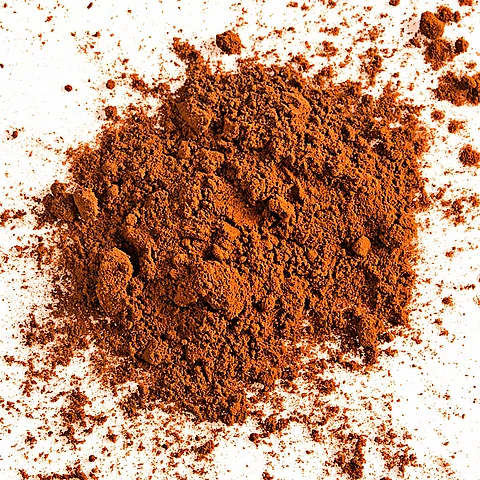
Powder form
The term ‘powder’ describes a state of matter in which a material consists of a multitude of discrete solid particles. These particles are unbound or only weakly bound and form a bulk material. Powdered substances therefore belong to the class of dispersed solid systems.
Compared to liquid or paste-like systems, powdered materials have a high specific surface area. At the same time, they contain voids between the particles that are filled with gas. A powdered product is therefore a multi-phase system consisting of solid and gas. “Powdered” describes a physical state and a technically and economically optimised form of substance delivery.
The powdered dosage form offers numerous technological advantages. Powders generally have good storage stability. Chemical and biological degradation processes proceed more slowly, as the mobility of the molecules is restricted. Particularly in the case of foodstuffs, pharmaceuticals and chemicals, the shelf life is significantly increased by the powdered form.
Furthermore, powders can be packaged and transported efficiently. The elimination of the liquid phase reduces the volume and mass per unit of product. This lowers storage, transport and energy costs. Additionally, powdered products are less sensitive to frost or temperature fluctuations than liquids.
A classic example of this is instant powder for beverages. Compared to the liquid product, it requires significantly less packaging volume. It has a longer shelf life and only when used is a liquid mixture produced again by adding water. The powdered form thus represents a concentrated, stable intermediate stage.
From a process engineering perspective, powdered substances can be handled in a wide variety of ways. They can be mixed, homogenised, agglomerated, coated, wetted, dried or reacted. Thermal processes such as tempering or calcination are also possible. This flexibility makes powder a preferred dosage and process form.
At the same time, the powder form places high demands on process engineering. For example, flow behaviour, dust generation, segregation and reactivity must be specifically controlled. The properties of powdered substances depend heavily on particle size, particle shape, particle structure and packing density.
 Blog
Blog






 Related pages