

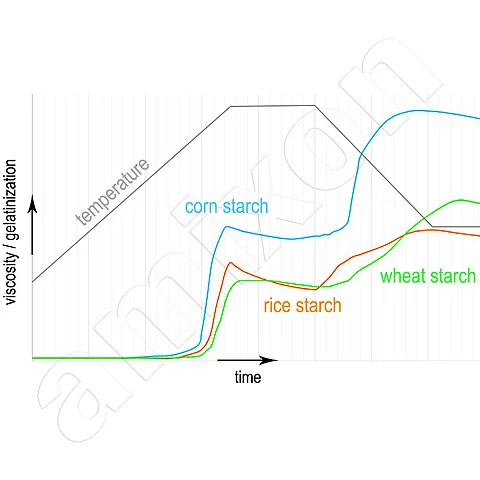
Pasting properties
The term describes a substance's ability to swell upon contact with liquids, bind water, and form a viscous or gel-like structure. The term originally comes from starch chemistry, but today it is also used for cellulose derivatives and other thickeners.
In starch, pasting occurs when starch granules are heated in water. The granules swell, crystalline regions dissolve, and amylose leaches out. The suspension thickens. A pasty or gel-like structure is formed. The pasting temperature and the resulting viscosity depend on the starch type, the water content, and the thermal treatment.
Cellulose derivatives such as methylcellulose, hydroxyethylcellulose, or carboxymethylcellulose also exhibit pronounced pasting and thickening properties. They form structurally viscous solutions in water. These properties are deliberately used in chemistry, construction chemistry, the food industry, and pharmacy.
Other thickeners from the chemical industry also show comparable effects. In construction chemistry they control the consistency, the working time, and the water retention capacity. In foods they influence texture, mouthfeel, and stability. In lubricants they regulate flowability and adhesion. With metal powders, pasting properties are used to stabilize suspensions, bind powders, or support forming processes.