

Loosening powder by introducing air
With a sufficient volume of air, a bulk material can transition into a fluidised state. It then behaves approximately like a low-viscosity liquid. The term ‘fluidisation’ is used when the buoyancy force of the gas flow nearly compensates for the effective weight of the particles.
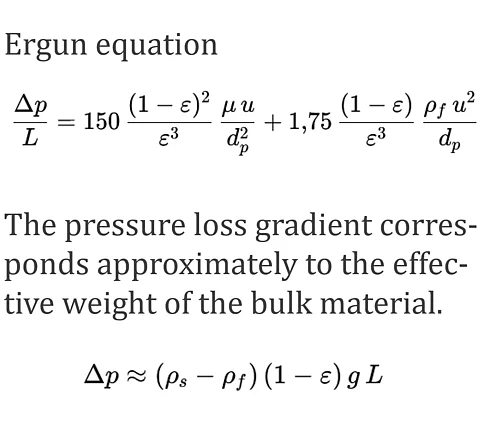
A simple model equation for flow through a stationary fluidised bed is the Ergun equation:
Δp/L = 150 · (1− ε)2 /ε3 · μ · u/(dp)2 + 1.75 · (1− ε) /ε3 · ρf · u2/dp
- Δp is the pressure drop across the bed length L
- ε is the porosity
- μ is the viscosity of the fluid,
- u is the superficial velocity. Superficial velocity is the apparent flow velocity of a fluid through a cross-section through which it flows
- dp is the particle diameter
- ρf is the density of the fluid
When the pressure drop per unit height is approximately equal to the weight of the bulk material, the minimum fluidisation velocity is reached. Above this velocity, gas bubbles form, and the powder exhibits distinctly liquid-like behaviour.
Heavily aerated fine powders can thus escape uncontrollably from small openings. This is referred to as flushing, i.e. a difficult-to-control, liquid-like outflow.