

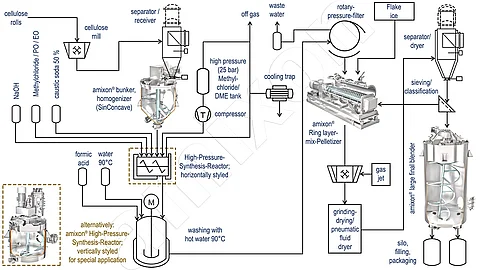
HPMC process
Hydroxypropyl methylcellulose: This is a chemically modified cellulose derivative. The starting material is highly pure cellulose from wood or cotton.
First, the pulp is cleaned, comminuted, sieved, and dried. This produces a defined particle size distribution with adjustable residual moisture. In the next step, the cellulose is alkalized. For this, sodium hydroxide is added. The cellulose swells and its hydroxyl groups are activated.
Etherification then follows. The alkaline cellulose reacts with methylation and hydroxypropylation reagents. Typical reagents are chloromethane and propylene oxide. In the process, hydroxyl groups are partially substituted. This generates methoxy and hydroxypropyl groups on the cellulose. After the reaction, the reactor is depressurized. Unconsumed reaction gases are drawn off and often recovered. Excess lye is neutralized. The pH is then adjusted to the neutral range.
The product is then washed. In several washing stages, salts, by-products, and residual solvents are removed. The solid is filtered or centrifuged. The wet HPMC cake is dried. For this, for example, belt, fluidized-bed, or vacuum dryers are used. The product is then milled, sieved, and homogenized.
By selecting the raw materials and reaction conditions, the properties of the product can be adjusted. Of great importance here are the degrees of substitution and viscosity grades. They influence solubility, gel formation, and flow behavior. HPMC is soluble or swellable in water. It acts as a thickener, stabilizer, and film former. HPMC is widely used in construction chemicals, and in paints and coatings. In the pharmaceutical industry, HPMC serves as a binder, film former, and matrix former for sustained-release tablets. In foods and cosmetics, HPMC is used as a stabilizer and texturizer.