

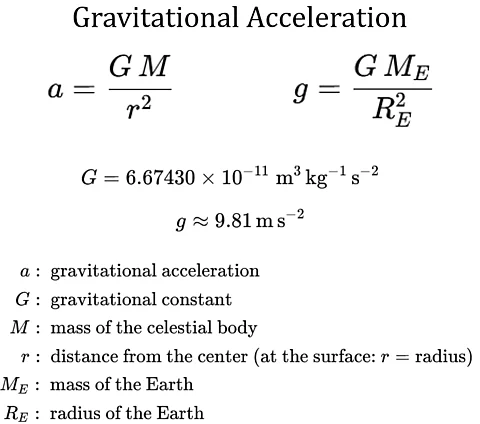
gravitational acceleration
Gravitational acceleration describes the acceleration that a mass experiences in the gravitational field of a celestial body when only the gravitational force acts (free fall without air resistance). It is usually denoted by the symbol g. Near the Earth's surface, g is on average about 9.81 m/s², but it varies slightly with latitude and altitude. Due to the Moon’s lower mass, gravity there is only 1.62 m/s². This corresponds to about one sixth of Earth’s gravity.
In classical mechanics, gravitational acceleration follows from the law of gravitation and Newton’s second law. For a celestial body assumed to be spherical with mass M and radius r, the following holds:
a = G * M / r²
- a: gravitational acceleration
- G: gravitational constant
- M: mass of the celestial body
- r: distance from the center (at the surface: r = radius)
At the Earth’s surface, this is usually written as:
g = G * M_E / R_E^2
- M_E: Earth’s mass
- R_E: Earth’s radius
Gravitational acceleration is the reason that bodies in free fall continuously change their velocity and, near Earth, accelerate downward. In many engineering calculations, g is taken as a constant with 9.81 m/s², for example in fluid mechanics, statics and dynamics, or in the design of silos and bulk material equipment, whenever weight forces and gravity-driven flows need to be considered.