

freeze-drying
In freeze-drying (also called lyophilization), water is transferred from a previously frozen product directly from the solid to the gaseous state (sublimation) without passing through the liquid state. For this, the product is first deep-frozen and then kept at greatly reduced pressure in a drying chamber, while a condenser deposits the resulting water vapor as ice. The product temperature must remain below the critical product temperature to avoid structural collapse (eutectic or collapse point).
The process is described in three phases:
- Freezing phase: The product is cooled on a temperature-controlled shelf to a temperature below its freezing point, so that the water it contains crystallizes.
- Primary drying: Under vacuum and moderate heating, the ice sublimates, so that most of the water is removed and deposited on the ice condenser.
- Secondary drying: The remaining, more strongly bound residual moisture is removed by desorption at further reduced pressure and increased temperatures until the desired final moisture content is reached.
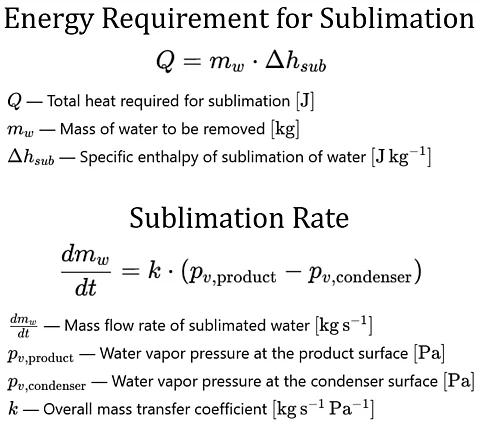
A key aspect is the energy required for the sublimation of ice. Approximately:
Q = m_w * Δh_sub
- Q: heat required for sublimation
- m_w: mass of the water to be removed
- Δh_sub: specific enthalpy of sublimation of water
The sublimation rate essentially depends on the difference between the water vapor pressures over the product and over the condenser:
dm_w/dt ∝ (p_v,product − p_v,condenser)
- dm_w/dt: mass flow of the sublimated water
- p_v,product: water vapor pressure at the product surface
- p_v,condenser: water vapor pressure at the condenser
Freeze-drying is used primarily for thermally sensitive or structure-critical products, for example for pharmaceutical active ingredients, vaccines, enzymes, cultures, instant foods, high-quality coffee, or fruits, because this process largely preserves the shape and pore structure of the dried products. The resulting porous matrix allows rapid rewetting and reconstitution.
 Blog
Blog