
free-fall mixture
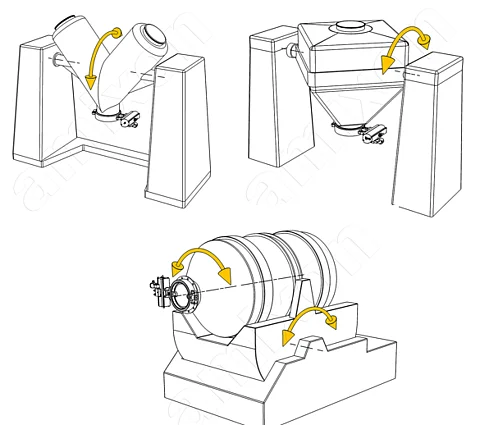
In free-fall mixing, the bulk material is redistributed inside the container by gravity without the use of active mixing tools. The mixing container itself is moved, typically by rotating, tumbling or tilting. This causes the product inside to lift repeatedly and flow together in free fall. The mixing is achieved by these periodic falling and rearrangement processes and not by shovels, ploughs or screws in the product.
Free-fall mixing is primarily used for dry, free-flowing and fragile bulk materials that should only be exposed to low mechanical stress. The speeds are usually selected so that the centrifugal forces remain low and the product actually falls instead of being "pressed" against the wall. Liquid additives or highly cohesive, sticky products are generally unsuitable for free-fall mixers, as sufficient shearing action and active disintegration of agglomerates cannot be guaranteed.
Typical designs for free-fall mixing include rotary containers, double cone, V-shaped or drum mixers. Simple baffles or impact elements are often arranged inside to direct the product flow and enlarge the mixing zones. Characteristic features include comparatively low drive power, a rather passive mixing principle and a limited range of applications in terms of product diversity, fine particle content, moisture and mixing ratio.
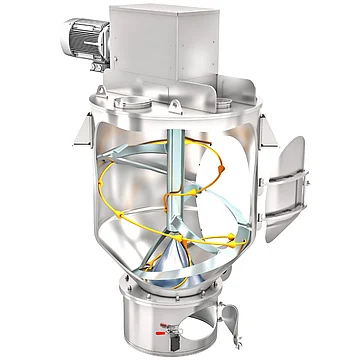
amixon® does not manufacture free-fall mixers. However, similar gentle mixing processes can be achieved with the "Vertical Twin-Shaft Mixer Type HM" and "KoneSlid Type KS" mixing systems. These all-rounders generally achieve higher mixing qualities. They can also be emptied more quickly and completely.