

Experimental procedure
The experimental procedure covers all stages, from defining the objectives through to the structured analysis of the data. The aim is to produce reliable, comparable and scalable results. At the outset, the objectives and experimental parameters are defined. These include material data, the apparatus configuration, the process conditions and the measured variables. All parameters are defined, set, continuously monitored and documented. Deviations from the setpoint are recorded along with their cause, duration and intensity.
Data collection is carried out systematically, often using the Design of Experiments (DoE) methodology. This enables the identification of main effects and interactions. Reproducibility is verified through repeated trials and assessed using metrics such as the standard deviation or the confidence interval.
During operation, the process parameters are continuously monitored. The heat transfer rate, for example, can be calculated using the formula:
Q˙= m˙⋅ cp ⋅ ΔT
- Q is the heat transfer rate
- m˙ is the mass flow rate of the heat transfer fluid
- c_p is the specific heat capacity
- ΔT is the temperature difference
If heat transfer takes place across a surface, the following applies as an approximation
Q˙= U⋅ A⋅ ΔT_log
- U is the overall heat transfer coefficient resulting from convection, conduction through the wall and convection
- A is the heat transfer area
- ΔT_log is the logarithmic mean temperature difference.
Dimensional analysis is used to assess the generalisability of the results. The Reynolds number, for example, characterises the flow regime of a fluid:
Re = ρ⋅ v⋅ L / μ
- Re is the Reynolds number
- ρ is the density
- v is the characteristic velocity
- L is the characteristic length
- μ is the dynamic viscosity
The Nusselt number describes convective heat transfer:
Nu = α · L / λ
- Now it's the Nusselt number
- α is the heat transfer coefficient
- L is the characteristic length
- λ is the thermal conductivity
The Newton number describes viscous flow and serves as a dimensionless performance indicator for agitators.
Ne = P / (ρ⋅n³⋅D⁵)
- Ne is the Newton number
- P is the power
- n is the rotational speed
- D is the diameter of the stirrer
The classic dimensionless parameters, such as the Reynolds, Nusselt and Newton numbers, apply primarily to liquids and gases. Bulk solids behave in a much more complex manner, as particle size, particle shape, friction, cohesion and agglomeration all play a role. Generally applicable parameters are therefore rarely applicable.
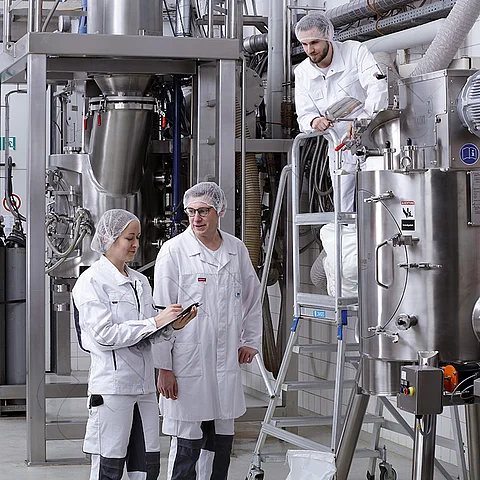
Practical mixing trials at the amixon® technical centre replicate the actual product behaviour in the production unit. They provide direct insights into homogeneity, material protection, the tendency to segregate and process windows. They establish a reliable basis for design and scale-up and help to minimise risk.
It is necessary to install test mixers at the customer’s premises if real-world feedstock properties such as freshness, temperature, sterility or the exclusion of external atmospheres cannot be replicated in the pilot plant.
 Blog
Blog