

discharge device
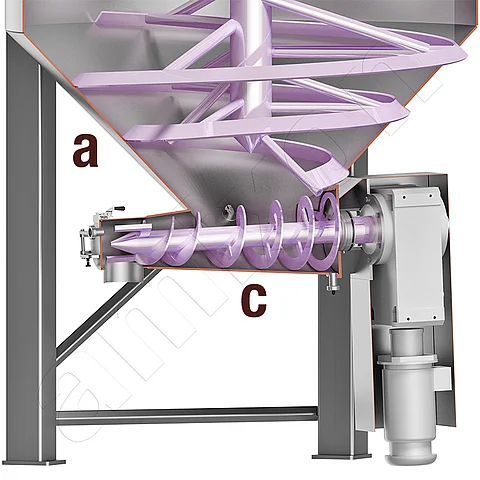
Shown on the left is an amixon® mixing silo/fermenter designed for particularly high-viscosity substances. The mixing tool a) can be operated in reverse mode, either for filling and mixing or for discharge. The same applies to the conical discharge screw c)
A discharge device is a functional component located at the outlet of a container or mixer. It controls the discharge of the product. It determines when and at what rate a bulk material or liquid is discharged. Typical discharge devices include dosing screws, rotary valves, slide gates, flaps, vibrating chutes and dosing belts. For free-flowing liquids or powders, slide gates, flaps or rotary valves are sufficient. The poorer the flow properties of the material, the more complex the discharge devices must be designed.
They work in conjunction with gravity by generating forced flow. The mass flow can be regulated via speed, stroke or opening angle. The design of the discharge mechanism has a significant influence on flow behaviour, dosing accuracy and the prevention of bridging or silo formation. In bulk material handling, discharge devices are often combined directly with weighing equipment to enable gravimetric dosing. In hygienically sensitive applications, the discharge device in contact with the product is usually made of stainless steel and is designed to be easy to clean and CIP-compatible where required. A further requirement is then that it must be ‘quick to dismantle’.