

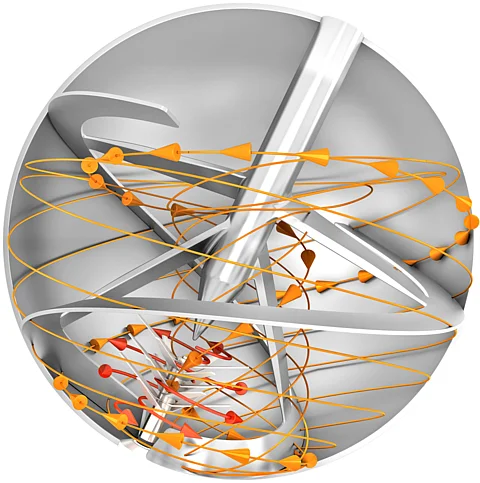
Cross-flow
Image: Cross-flows are created due to the angled position of the mixing shafts. Gravity acts perpendicular to the direction of flow. Cross-flow refers to a flow pattern in which the flowing medium moves perpendicular to the main direction of a mass flow or perpendicular to the main geometric axis of a piece of equipment. It frequently occurs where flows are deflected, superimposed or influenced by internal components.
In process engineering, cross-flow is specifically employed to improve mass transfer, heat transfer, mixing or cleaning effects. The cross-flow reduces boundary layers, increases particle contact and breaks up inhomogeneous zones. This is particularly significant in multiphase, powder or bulk material processes.
In mixers, reactors or dryers, cross-flow can significantly improve the uniformity of the process. Its characteristics are determined, among other things, by the apparatus geometry, internal components, flow velocity and product properties. It is an important design parameter for efficient and reproducible processes.

 Blog
Blog