

Centrifuge
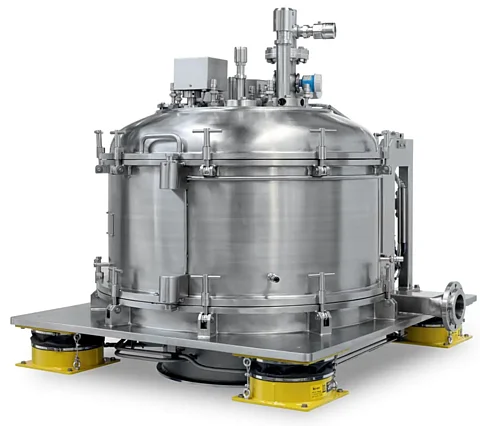
Left image of a centrifuge from Ferrum Process Systems. A centrifuge is a process engineering apparatus that allows substances to be separated using centrifugal forces. In this process, a mixture of substances is rotated so that different accelerations act on the individual phases. Denser components are pushed outward, while lighter ones remain closer to the axis of rotation.
Centrifugal separation of substances contrasts with separation by filtration in several fundamental respects. While centrifuges utilize density differences and operate with high centrifugal acceleration, filtration is based on spatial separation through a filter medium with a defined pore size.
- Centrifugation therefore separates liquids or suspensions along the radial field (inside/outside).
- Filtration separates liquid from solid along a fixed separation layer (in front of the filter/behind the filter).
Centrifuges are used to separate solids from liquids, to separate liquids of different densities, or to selectively remove solid fractions. The separation effect is significantly higher than with pure gravity sedimentation.
In process engineering, different types of centrifuges exist. These include drum centrifuges, decanters, separators, and filter centrifuges. The selection of the appropriate centrifuge depends on particle size, density differences, throughput, and the desired separation sharpness.
The separation performance of a centrifuge depends on rotational speed, drum diameter, and residence time. As rotational speed increases, centrifugal acceleration rises sharply. This makes it possible to efficiently separate even fine particles or small density differences.
Centrifuges are used in chemical, food, pharmaceutical, environmental, and processing technology. They are robust devices for continuous or discontinuous processes that enable compact and high-performance separation.