

Absorption tendency
The term ‘absorption’ should be considered in conjunction with the term ‘adsorption’. Both processes describe the attachment of a foreign substance to an adsorbent or absorbent. The difference, however, is as follows:
In absorption, molecules/atoms/ions penetrate the interior of the absorbent and distribute themselves evenly within it. In absorption, the entire volume of the absorbent is involved in the attachment of the pollutants. A liquid or gas penetrates the internal structure of the absorbent and can dissolve within it. Example: Carbon dioxide is dissolved in water. This process is also reversible if the pressure of the liquid is reduced. A towel is also an absorbent when used to dry a surface.
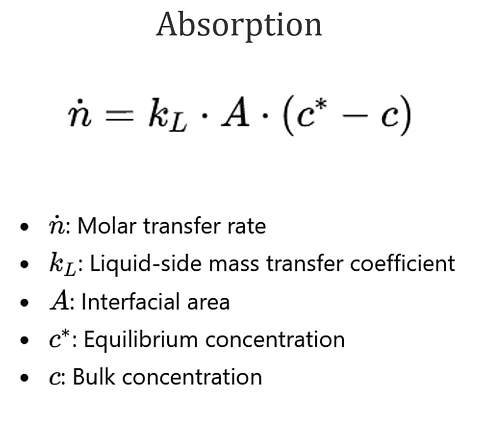
\dot{n} = k_L \cdot A \cdot (c^* - c)
- n˙: mass flow
- k_L: mass transfer coefficient (liquid side)
- A: exchange area
- c∗: equilibrium concentration
- c: actual concentration
In everyday language, the term ‘sound absorption’ is used: the energy of the vibrating air (sound waves) is converted into frictional heat. This physical process is irreversible. However, many other absorption processes are reversible, regardless of whether they are chemical or physical absorption processes.
In adsorption, the foreign substance molecules are attached to the surface of the adsorbent via molecular or interparticle binding forces. This process is utilised in filtration.
Adsorbent materials generally have a high specific surface area and a high affinity for certain foreign substances. One example is air dehumidification using lithium hydroxide or silica gel. Or the attachment of pollutants to activated carbon. Adsorption processes can be irreversible or reversible, regardless of whether they are chemical or physical adsorption processes.
The two phenomena of absorption and adsorption are of great importance for the wetting of powders and agglomeration.
Absorption and adsorption are reversed when moist powders are heated. The liquid phase evaporates. The drying process can be accelerated by applying a vacuum.Visual aid
Visual aid
- Absorption: The substance goes in.
- Adsorption: The substance stays on it.