

The Invisible Ingredient: Why the Mixing Process Determines the Quality of Every Baking Product
amixon GmbH highlights that baking agents and mixes can contain over 50 ingredients that must be distributed with extreme homogeneity, especially when added at only 1–5% to flour, to ensure texture, volume, crumb, and shelf life. The company outlines three key mixing challenges—uniform dispersion of diverse particles, controlled liquid addition without clumping, and minimal heat input—amid rising demands for smaller batches, allergen management, and rapid changeovers. amixon offers tailored systems: HM twin-shaft mixers for liquid-laden formulas, AM conical mixers for near-complete discharge and fast cleaning, KoneSlid KS for segregation-free precision, and VMT vacuum mixing dryers for controlled thermal processing, supported by global pilot testing to de-risk investments.
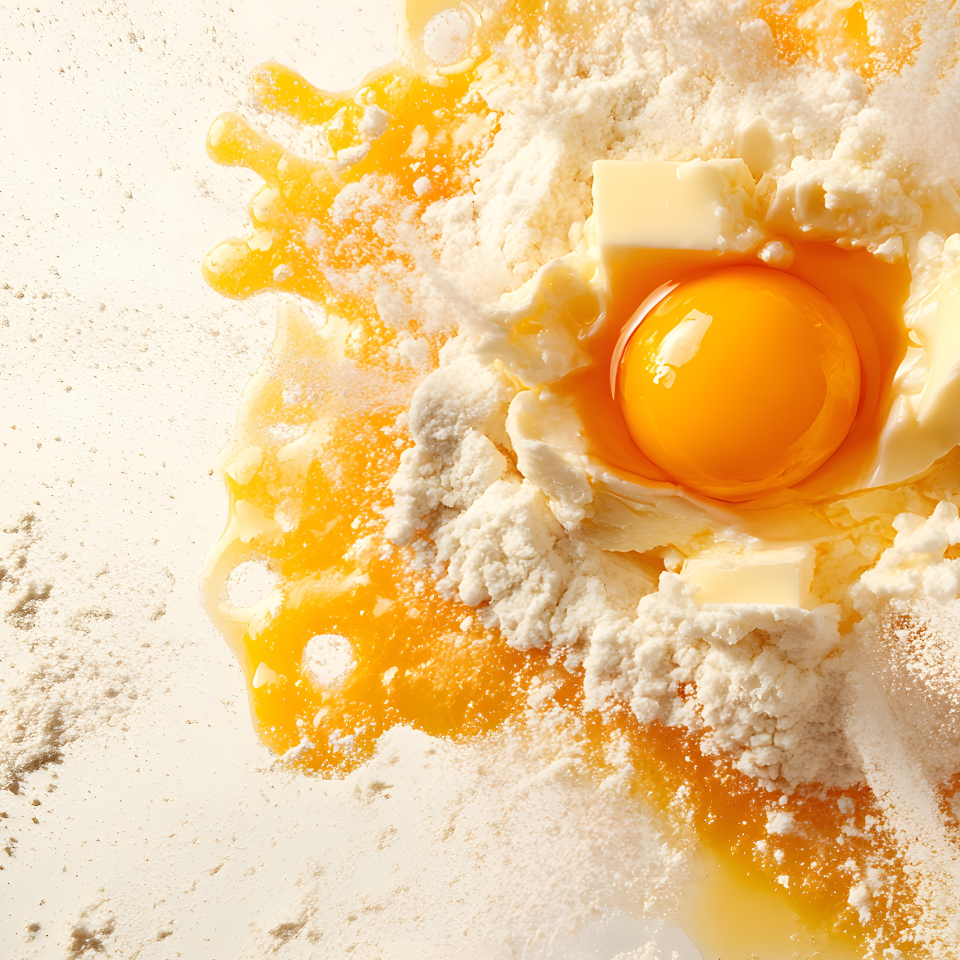
Baking ingredients and mixes often consist of more than 50 components.
What sets baking agents apart from other powders
amixon GmbH, based in Paderborn, is a specialized manufacturer of mixing systems for the industrial production of baking agents, baking mixes, and ready-to-bake flour preparations. The foundation is a deep understanding of product properties: baking aid concentrates consist of more than 10, sometimes over 50 individual components—enzymes, emulsifiers, leavening agents, lecithins, starch derivatives, whey powder, and functional fats. These are added to the flour in industrial bakeries at a concentration of only about 1% to 5%—but must nevertheless be distributed absolutely homogeneously, as they directly determine the texture, volume, crumb, and shelf life of the baked goods.
Three Key Challenges in Bakery Ingredient Production
The production of high-quality baking agents and premixes places three simultaneous demands on mixing technology:
- Homogeneity despite extreme component diversity: Hydrophilic and hydrophobic substances, ultra-fine powders, and granules with varying bulk densities and particle sizes must be evenly distributed—and must not segregate again during product discharge
- Controlled liquid addition without clumping: Oils, lecithins, baking extracts, honey, syrups, and highly viscous substances must be finely atomized and introduced into the moving powder bed—every particle should be wetted according to the recipe; excessive concentrations impair flowability and storage stability
- Minimal heat input during mixing: If the baking agent heats up during the mixing process, its flowability deteriorates—the product may clump after packaging and is then neither dispensable nor marketable
In addition, market demands are growing: Customers expect smaller batch sizes, clearly declared ingredients, allergen-free production lines, and short delivery times. Contract manufacturers must switch between many recipes daily—residue removal, cleaning efficiency, and product sequencing thus become key operational metrics.
The production of high-quality baking agents and premixes places three simultaneous demands on mixing technology:
- Homogeneity despite extreme component diversity: Hydrophilic and hydrophobic substances, ultra-fine powders, and granules with varying bulk densities and particle sizes must be evenly distributed—and must not segregate again during product discharge
- Controlled liquid addition without clumping: Oils, lecithins, baking extracts, honey, syrups, and highly viscous substances must be finely atomized and introduced into the moving powder bed—every particle should be wetted according to the recipe; excessive concentrations impair flowability and storage stability
- Minimal heat input during mixing: If the baking agent heats up during the mixing process, its flowability deteriorates—the product may clump after packaging and is then neither dispensable nor marketable
In addition, market demands are growing: Customers expect smaller batch sizes, clearly declared ingredients, allergen-free production lines, and short delivery times. Contract manufacturers must switch between many recipes daily—residue removal, cleaning efficiency, and product sequencing thus become key operational metrics.
Overview of amixon® Mixing Systems
amixon® offers specialized machine models for the production of baking agents and baking mixes, designed to meet a variety of requirements:
HM Series Twin-Shaft Mixer: optimized for baking agents containing liquid components. Dual-fluid nozzles finely atomize oils, lecithins, and baking extracts into the moving powder bed. The result: uniform wetting, minimal dust content, improved flowability—with short mixing times and low energy input.
AM Series Conical Single-Shaft Mixer: the top choice for contract manufacturers with frequently changing recipes. The conical design enables nearly complete residual discharge, reduces product carryover, and simplifies switching between allergen-free and allergen-containing batches.
KoneSlid® Mixer Type KS: for maximum mixing precision and segregation-free discharge. Particularly suitable for high-concentrate products, where even the slightest deviations in distribution affect baking performance.
Vacuum Mixing Dryer Type VMT: for the thermal processing of flours and grain derivatives. Mixing, heating, reaction, and drying take place in a closed process under vacuum. This allows for the targeted control of enzyme activity, the reduction of microbiological contamination, and the reproducible stabilization of water absorption and dough behavior—at moderate product temperatures.
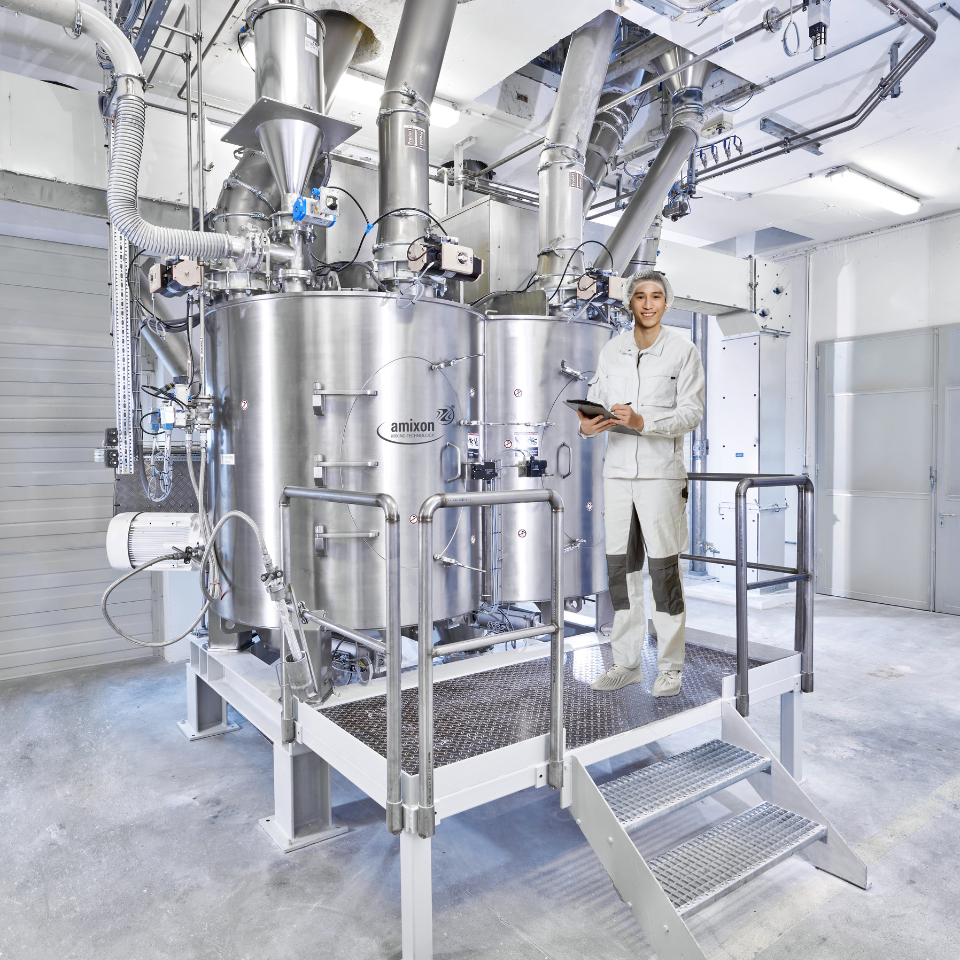
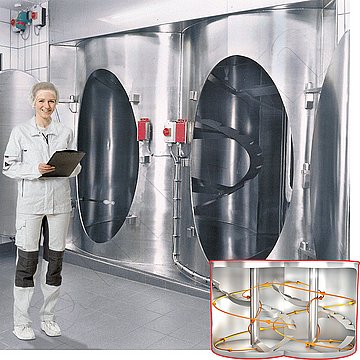
The HM twin-shaft mixer is optimized for baking ingredients containing liquid components.
amixon® offers specialized machine models for the production of baking agents and baking mixes, designed to meet a variety of requirements:
HM Series Twin-Shaft Mixer: optimized for baking agents containing liquid components. Dual-fluid nozzles finely atomize oils, lecithins, and baking extracts into the moving powder bed. The result: uniform wetting, minimal dust content, improved flowability—with short mixing times and low energy input.
AM Series Conical Single-Shaft Mixer: the top choice for contract manufacturers with frequently changing recipes. The conical design enables nearly complete residual discharge, reduces product carryover, and simplifies switching between allergen-free and allergen-containing batches.
KoneSlid® Mixer Type KS: for maximum mixing precision and segregation-free discharge. Particularly suitable for high-concentrate products, where even the slightest deviations in distribution affect baking performance.
Vacuum Mixing Dryer Type VMT: for the thermal processing of flours and grain derivatives. Mixing, heating, reaction, and drying take place in a closed process under vacuum. This allows for the targeted control of enzyme activity, the reduction of microbiological contamination, and the reproducible stabilization of water absorption and dough behavior—at moderate product temperatures.
The HM twin-shaft mixer is optimized for baking ingredients containing liquid components.
Process reliability through pilot plant testing
Before designing a system, we offer trials of the mixing and cleaning processes at our in-house test center, using the customer’s original raw materials. In addition to the headquarters in Paderborn, there are technical centers in China, India, Japan, South Korea, Thailand, and the United States. For baking ingredient manufacturers and contract manufacturers introducing new formulations or optimizing existing processes, this means a measurable reduction in development risk prior to the investment decision.
Before designing a system, we offer trials of the mixing and cleaning processes at our in-house test center, using the customer’s original raw materials. In addition to the headquarters in Paderborn, there are technical centers in China, India, Japan, South Korea, Thailand, and the United States. For baking ingredient manufacturers and contract manufacturers introducing new formulations or optimizing existing processes, this means a measurable reduction in development risk prior to the investment decision.
Frequently Asked Questions (FAQ)
Which mixer type is best suited for baking ingredients containing liquid components such as oil or lecithin?
The amixon® HM twin-shaft mixer is particularly well-suited for this purpose. It features integrated dual-fluid nozzles that finely atomize liquids and gently introduce them into the moving powder bed—without causing local overconcentrations or clumping.
How can cross-contamination be avoided when recipes change frequently?
The AM single-shaft cone mixer enables nearly complete residual discharge and is designed for quick, thorough cleaning. It is therefore the preferred choice for contract manufacturers who perform daily product changes between allergen-containing and allergen-free recipes.
Can mixing processes for new baking agent formulations be tested in advance?
Yes. At its technical center in Paderborn and at other international locations, amixon® offers the opportunity to conduct mixing trials using the customer’s original raw materials. This allows mixing time, mixing quality, and cleaning performance to be reliably determined before an investment decision is made.
What distinguishes amixon® mixers from standard mixing systems in the food industry?
amixon® mixers are specifically designed for demanding powder mixtures with heterogeneous component profiles—a key feature is the dead-space-free design, which prevents segregation during discharge. All machine types are manufactured to food standards and designed for GMP-compliant production environments.
Which mixer type is best suited for baking ingredients containing liquid components such as oil or lecithin?
The amixon® HM twin-shaft mixer is particularly well-suited for this purpose. It features integrated dual-fluid nozzles that finely atomize liquids and gently introduce them into the moving powder bed—without causing local overconcentrations or clumping.
How can cross-contamination be avoided when recipes change frequently?
The AM single-shaft cone mixer enables nearly complete residual discharge and is designed for quick, thorough cleaning. It is therefore the preferred choice for contract manufacturers who perform daily product changes between allergen-containing and allergen-free recipes.
Can mixing processes for new baking agent formulations be tested in advance?
Yes. At its technical center in Paderborn and at other international locations, amixon® offers the opportunity to conduct mixing trials using the customer’s original raw materials. This allows mixing time, mixing quality, and cleaning performance to be reliably determined before an investment decision is made.
What distinguishes amixon® mixers from standard mixing systems in the food industry?
amixon® mixers are specifically designed for demanding powder mixtures with heterogeneous component profiles—a key feature is the dead-space-free design, which prevents segregation during discharge. All machine types are manufactured to food standards and designed for GMP-compliant production environments.
Learn more about the benefits of amixon® mixers for baking ingredients and premixes in our fact sheet!
 Related News

© Copyright by amixon GmbH