

Thermal oil
Thermal oil is a special oil for heat transfer. It circulates in closed systems. The goal is to achieve controlled heating of apparatus and processes. Thermal oils can be mineral or synthetic. They are suitable for high temperatures and have a high boiling point. Compared to water, they enable high process temperatures at moderate pressure.
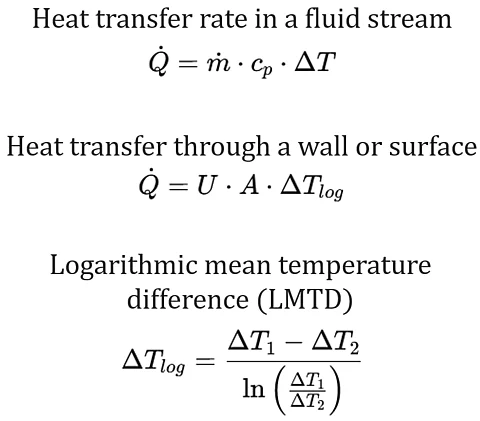
Heat output via mass flow
Q̇ = \dot m · c_p · ΔT
- Q˙ is the heat transfer rate
- m˙ is the mass flow rate of the heat transfer fluid
- cp is the specific heat capacity
- ΔT is the temperature difference
- U is the overall heat transfer coefficient (convection, wall conduction, convection).
- A is the heat transfer area
- ΔTlog is the logarithmic mean temperature difference
- ΔT1 = temperature difference at the inlet
- ΔT2 = temperature difference at the outlet
Heat transfer via the exchange surface
Q̇ = U · A · ΔT_log
Thermal oil is used in jacketed vessels, heating coils, heat exchangers, and temperature-controlled mixers. It plays an important role in chemical reactions, viscosity control, and product quality. Safety devices such as expansion vessels, inerting, and temperature monitoring are integral parts of thermal oil systems.
Logarithmic mean temperature difference (LMTD)
ΔT_log = (ΔT_1 - ΔT_2) / ln(ΔT_1 / ΔT_2)