

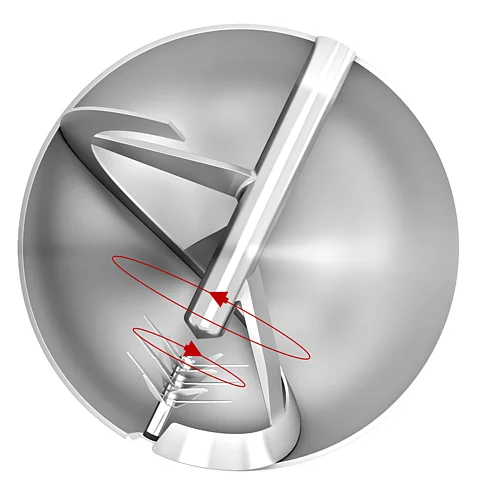
Spherization
Spheroidization is a process engineering method for shaping bulk material particles. In this process, irregularly shaped particles are specifically converted into an approximately spherical shape. The goal is to achieve a homogeneous particle geometry. This improves the flow, dosing, and processing properties of the bulk material.
In practice, spheroidization is carried out through mechanical, thermal, or agglomerative processes. Examples of this include the rotation process, fluidized bed processes, spray granulation, as well as melting and sintering steps. During this, particles are rounded through abrasion and plastic deformation. Alternatively, material layers can also be built up step by step.
Prilling is a thermal droplet formation and solidification process. This produces nearly spherical particles from a melt. During extrusion, cylindrical strands or pellets are initially produced. These can subsequently be spheroidized.
Spheroidized particles exhibit lower friction and better flowability. In addition, the bulk density is more uniform. This is relevant for applications in the chemical, food, pharmaceutical, battery, and plastics industries.
 Blog
Blog