
Shear flow
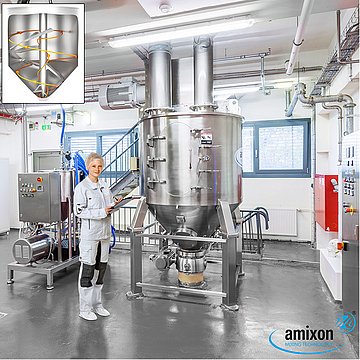
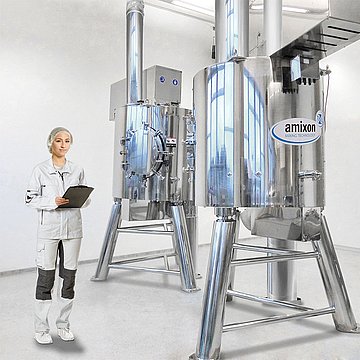
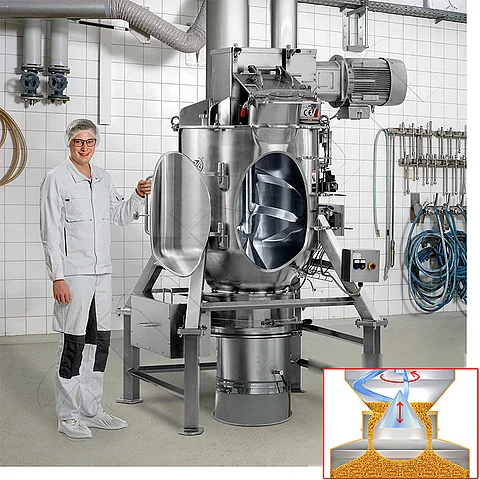
Modern precision mixers achieve ideal mixing results using gentle shear flows. The particles mix at low relative velocities. This ensures minimal stress on the particles.
A shear flow is a type of flow in which layers of material or clusters of particles are displaced parallel to one another. Predominantly tangential forces act, leading to relative motion between the layers without the occurrence of strong turbulent vortices or fluidisation. This occurs without the occurrence of strong turbulent vortices or fluidisation. In continuum mechanics, shear flow is often referred to as laminar shear flow.
In powder and mixing technology, there are powder mixers that operate on the principle of shear flow. In this process, powder beds are gently displaced and mixed by mechanical movement, resulting in comparatively gentle shear stress. This principle is particularly suitable for sensitive particles, crystals or coated granules.
In addition, there are mixing principles based on vortex flow. This results in turbulent flow structures and intense particle movement. In fluidising mixing processes, particles are suspended by gas or liquid flows. The choice of flow and mixing principle has a decisive influence on the shear stress and particle damage.
 Blog
Blog