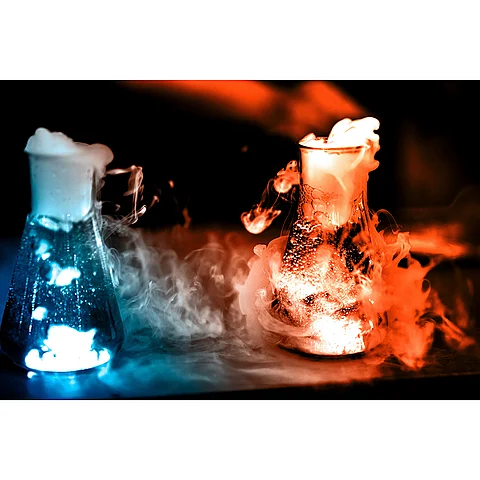
Pyrolysis
In pyrolysis, materials are thermally decomposed in the absence of oxygen. This process takes place at elevated temperatures, typically between 300 °C and 900 °C. Unlike combustion, no oxidation occurs. The chemical bonds in the feedstock are broken solely by the application of heat.
Pyrolysis breaks down complex organic molecules. This produces solid, liquid and gaseous products. These are referred to as pyrolysis coke, pyrolysis oil and pyrolysis gas. Their composition depends heavily on the process conditions. The process parameters – temperature, heating rate, residence time and pressure – are of crucial importance. The properties of the feedstock also play a central role. Pyrolysis is used on a wide variety of materials. These include biomass, plastics, waste tyres, sludge and organic residues. Pyrolysis is also used in chemistry and materials engineering.
In process engineering, it is frequently used for material or energy recovery. It enables the recovery of valuable materials. Furthermore, it allows for the targeted production of gases or oils.
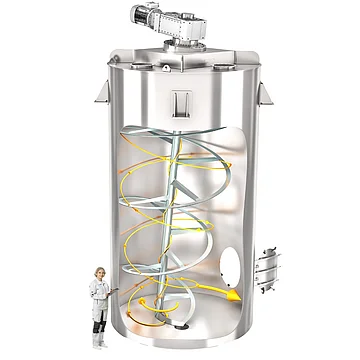
Reactions can be precisely controlled. By-products can be minimised. Pyrolysis is often an upstream thermal process. Downstream steps include, for example, condensation, separation or further chemical conversions. From a process engineering perspective, uniform temperature control and homogeneous material distribution are crucial. Inhomogeneities lead to incomplete decomposition and impair product quality. In such cases, appropriately sized Gyraton® mixing silos can be helpful.

 Blog
Blog