
Process Parameters
Process parameters are all relevant physical and chemical variables of a process. They are measurable, recordable, and analyzable. They describe the current state of a process as well as its changes over time.
The goal of recording process parameters is to enable targeted control of the process. Control variables can be adjusted based on the data obtained. This is intended to achieve an optimal process result. Process parameters are thus the foundation for reproducible quality, process stability, and cost-effectiveness.
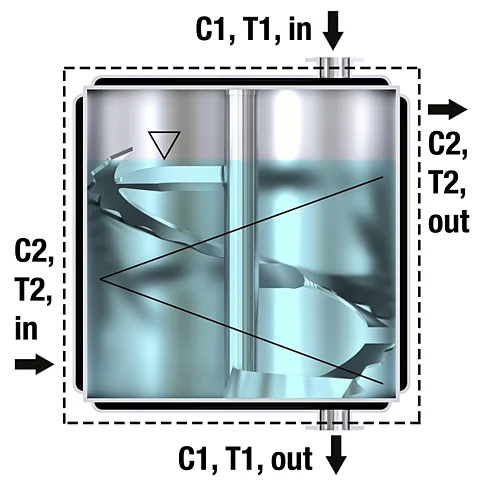
Typical process parameters include, for example, temperature, pressure, rotational speed of the mixing tools, power input, residence time, throughput, and moisture content. Depending on the process, additional variables may be included. These include, for example, changes in weight and volume, the amount of steam emitted, the gas composition, the vacuum level, or the heat flux. Time sequences and ramp-up profiles are also among the relevant parameters. A clear example is a vacuum drying process. This can be carried out in a vacuum contact mixer-dryer. In this process, product temperature, heating temperature, pressure, mixing tool speed, and drying time significantly influence the results. They directly affect the drying rate, energy consumption, and product quality.
amixon supports customers through practical process design and testing. One example is the blog post “amixon® helps with the sizing of large vacuum mixing dryer systems,” which examines relevant process parameters using specific examples.
 FAQ - Process Parameters
 Blog
Blog