
Powder logistics
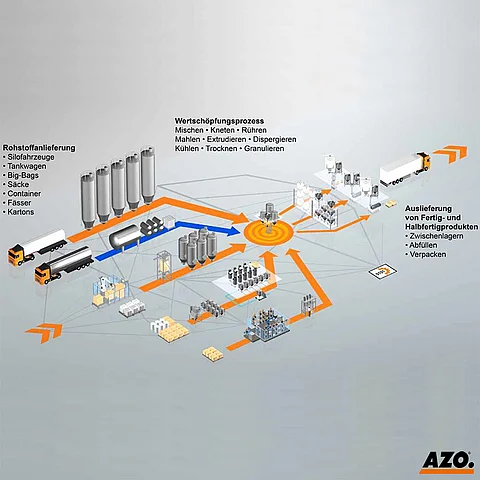
The term ‘powder logistics’ is directly linked to the growing need for automation. It describes the entirety of all in-house processes – from goods receipt and sampling through to storage, dosing and feeding of powders.
A look at the composition of common powder mixtures highlights the high level of complexity: instant drinks, sports nutrition and dietary supplements often consist of numerous powdered components. The same applies to construction chemicals, plant protection products, ceramic materials, powdered metals and pharmaceuticals. Liquid components are often added as well.
The number of raw materials involved is often surprisingly high. Each individual component must be clearly identified and correctly dosed. Furthermore, it must be fed in at the right time. In powder mixing plants, batches of approximately 1 m³ to 6 m³ are typically produced; in some cases, up to 12 m³. The composition often varies from order to order. The actual mixing time is comparatively short: typical mixing times range from 3 to 10 minutes, whilst emptying the powder mixer often takes only 20 seconds to a maximum of one minute. It is therefore clear that the mixing process itself is not the time-determining factor.
In many cases, the greatest challenge lies in the logistical provision of the raw materials. All components must be available on time, in full and in the correct quantities. In multi-step mixing processes, they must also be fed into the mixer in a defined sequence.
Following each recipe change, a suitable cleaning strategy must also be implemented. Depending on the degree of contamination and the sensitivity of the subsequent recipe, this involves complete emptying, dry cleaning or wet cleaning. These measures are necessary to prevent cross-contamination and ensure product quality.
Efficient powder logistics therefore requires a high degree of automation, as manual processes quickly reach their limits. As a rule, delivered raw materials are first transferred into the plant’s own vessels, containers, silos or big-bag stations. Only then are they accessible for automated processes. This intermediate storage facilitates the automation of in-house dosing, simplifies transport and enables the timely provision of raw materials. Upon transfer to the company’s own infrastructure, a routine quality check can also be carried out: silo goods are often screened during storage, and samples are additionally taken and documented.
Powder logistics is therefore far more than a mere transport problem – it is an integral part of the value chain. Large powder producers have highly complex logistics concepts in which material flows, buffer capacities, cleaning and cycle times are closely interlinked. High efficiency can often only be achieved with the aid of simulations. Digital models help to identify bottlenecks and support targeted process optimisation. As the quality and availability of process data improve, artificial intelligence can also be deployed: it enables the forecasting of material requirements and optimises sequencing, storage strategies and plant utilisation.
 Blog
Blog
 Related pages