Pipe flow
Pipe flow and vessel flow are two fundamental concepts in continuous powder mixing. Both flow types differ significantly in their process behaviour. Which solution is better always depends on the specific application.
In pipe flow, the bulk material is continuously transported through a largely tubular mixing chamber.
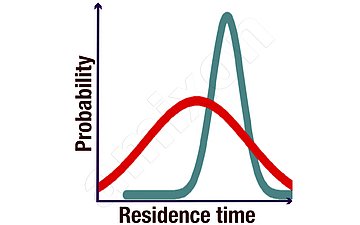
Mixing takes place during axial flow. Ideally, the flow approximates a plug flow. Axial back-mixing is minimal. The particles move through the mixer with a similar residence time.
A key parameter is the mean residence time. It describes the average time a particle spends in the system.
tm = V/V˙
- t is the mean residence time
- V is the effective mixing volume
- V˙ is the volumetric flow rate
In tubular flow, it is not only the mean residence time that is relevant, but above all its distribution. The residence time distribution is comparatively narrow. This promotes consistent product quality. Temperature or moisture profiles can be easily controlled. Pipe flow is therefore particularly suitable for sensitive formulations and products with tight specifications.
The counterpart to pipe flow is continuous-flow batch mixing. Here, the powder is located in a mixing vessel with simultaneous inflow and outflow. The batch is ideally regarded as a fully mixed system. At any given moment, the composition is homogeneous throughout the entire batch.
In batch mixing too, the mean residence time is derived from the ratio of volume to throughput. The decisive difference lies in the residence time distribution. For the ideally mixed batch, an exponential distribution results.
E(t) = 1/tm ⋅ exp (−t/tm)
- E(t) is the residence time density function
- t is the individual residence time of a particle
- tm is the mean residence time
This distribution means that there is no fixed minimum residence time. Some of the particles leave the reactor very early. Other particles remain in the system for significantly longer. The variation in residence times is large. The variance of the residence time is given by
(σt)2 = (tm)2
(σt)2 is the variance of the residence times. This strong back-mixing has process engineering implications. The vessel mixing acts as a buffer. Fluctuations in the feed are compensated for. Process control is robust. This is advantageous in the case of difficult material properties or unstable boundary conditions.
The Peclet number is frequently used for the quantitative description of back-mixing. It allows classification between pipe and kettle flow.
Pe = u⋅L/Dax
- Pe is the Peclet number
- u is the mean axial flow velocity
- L is the characteristic length of the mixing chamber
- Dax is the axial dispersion coefficient
High Peclet numbers indicate a pipe flow-like behaviour with low back-mixing. Low Peclet numbers indicate strong back-mixing and a kettle-like behaviour.
Pipe flow and continuous kettle mixing are therefore not competing processes in the sense of being better or worse. They represent different process engineering tools. Pipe flow offers tight residence time distributions and high process dynamics. Kettle mixing offers stability and a buffering effect.
The selection of the appropriate flow pattern has a significant influence on mixing quality, product consistency, controllability and cost-effectiveness. It is a key step in the design of continuous powder mixing processes.
On the amixon website blog, you will find articles on continuous powder mixing:
- Pipe flow versus vessel flow
- Continuous mixing versus batch mixing
 Blog
Blog