

Oxidation-sensitive powders
Oxidation-sensitive powders are solid, mostly organic substance systems that undergo chemical changes as soon as they come into contact with the oxygen contained in the air. Many foods contain fats, proteins, vitamins, natural flavours and colourings. These are degraded by autoxidative processes or radical chain reactions. This leads to rancidity, loss of flavour, colour changes and the degradation of valuable ingredients.
Oxidation stability is particularly important for instant products, as they need to remain storable for long periods without refrigeration. Oxidation can not only damage molecules directly, but also activate or promote enzymatic reactions. This happens, for example, through the provision of reaction partners or through changes in the water balance. This can accelerate the action of lipolytic or proteolytic enzymes.
In powdered foods, various factors promote oxidative processes. These include a high content of unsaturated fatty acids, a large specific surface area, residual moisture, elevated storage temperatures and the presence of transition metal ions, which act as catalysts. Exposure to light and repeated temperature fluctuations can also increase the rate of oxidation. From a powder technology perspective, finely ground or spray-dried systems with a porous structure are particularly critical.
The packaging should act as both a water vapour barrier and an oxygen barrier. Sometimes oxygen absorbers in special sachets are packaged together with the food powder. Typically, these absorbers consist of finely distributed iron powder, which reacts with oxygen to form iron oxide. This iron powder is mixed with salts and sometimes with activated carbon or mineral carriers to accelerate the reaction and buffer moisture. Such mixtures in the approved sachet form are considered food-safe, tasteless and safe for the product because the contents cannot migrate into the food. The sachets are only added after the mixing process in the packaging machine.
Oxygen reduction: This can be achieved by replacing the ambient air with an inert gas, such as nitrogen or a noble gas.
Such an inert atmosphere can also be created in amixon® powder mixers. This procedure is particularly effective when the mixing chamber is first evacuated and then flooded with an inert gas.
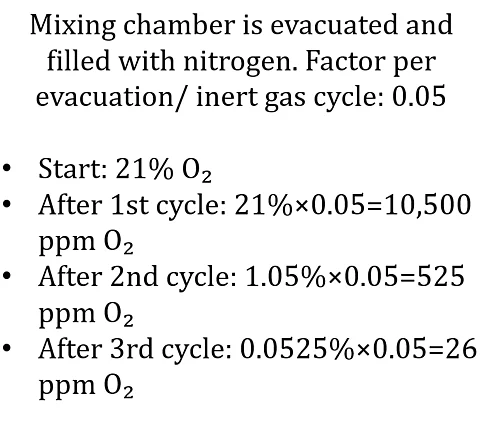
When evacuating from 1 bar to 50 mbar, 5% of the original gas volume remains (50 mbar / 1000 mbar = 0.05). When subsequently filling with pure nitrogen, the amount of oxygen remains the same, but is ‘diluted’ to 1 bar. The factor per evacuation/inert gas cycle is therefore 0.05.
· Start: 21% O₂.
· After the first cycle, it is 1.05%.
· After the second cycle, it is 0.0525%, after the third cycle 0.002625%.
· After the third cycle, it is 0.002625%.
This process control can be used for mixers with both an empty mixing chamber and an already filled, dry powder volume if the powders do not fluidise.