liquid agitator
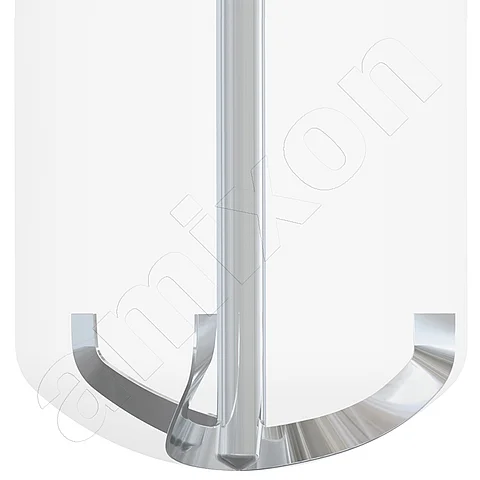
A liquid agitator is an agitator that is primarily used for mixing, homogenising or suspending liquids and liquid systems (solutions, suspensions, emulsions). It typically consists of a drive, a stirring shaft and a stirring element (e.g. propeller, Rushton turbine or anchor stirrer) that rotates in the liquid and generates currents in the container. These currents ensure the transport of substances and heat and the adjustment of defined shear conditions.
Dimensionless parameters are often used to describe the operating mode of liquid agitators. A key parameter is the agitator parameter (performance coefficient):
Ne = P / (ρ * n³ * d⁵)
- Ne: Stirrer efficiency (power factor)
- P: Agitator power [W]
- ρ: Density of the liquid [kg/m³]
- n: Rotational speed [1/s]
- d: Agitator diameter [m]
The stirrer index can be used to transfer performance from laboratory to production scale in cases of geometric similarity. For low-viscosity liquids, the Reynolds number of the stirrer is also relevant.
Re = (ρ * n * d²) / μ
- Re: Reynolds number of the stirrer
- μ: Dynamic viscosity [Pa·s]
- Small Re → laminar stirring (viscous, ordered flow)
- Large Re → turbulent stirring (intensive mixing).
Liquid agitators are generally less suitable for poorly flowing materials such as suspensions or powders.
 Blog
Blog