

Innovation pace
The innovation pace describes the speed at which new products, processes, or business models emerge, spread, and displace existing solutions. It determines the dynamics of productivity and economic growth, as more frequent innovation leaps change value chains in shorter cycles.
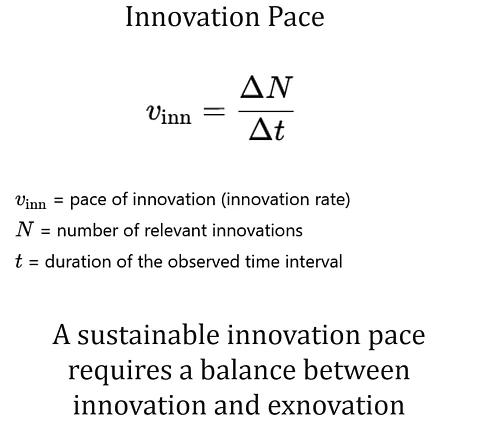
In economics, the innovation pace can be approximated as the innovation rate, for example, as the number of significant innovations per unit of time:
v_inn = ΔN / Δt
- v_inn is the pace of innovation (innovation rate)
- N is the number of relevant innovations
- t is the duration of the interval under consideration.
A significant increase in the innovation pace increases the complexity of interconnected socio-technical systems and can, similar to a "speed limit," increase the risk of instabilities and misalignments. Therefore, a sustainable innovation pace requires a balance between the introduction of new technologies (innovation) and the orderly withdrawal of outdated technologies (exnovation).
In industrial practice, the innovation pace is mainly influenced by R&D investments, organizational learning capability, and the quality of external knowledge networks. Excessive acceleration can lead to friction losses, rework, and decreased efficiency.