

Inert gas purging
When inertizing mixers, the Pressure-Swing method describes how the oxygen content is gradually reduced through repeated evacuation and subsequent pressurization with inert gas. The starting point is a mixer chamber filled with air with an initial oxygen content c_(O2,0) of about 0.21 (21%). The mixer is first evacuated to a vacuum and a defined portion of the gas phase is removed. Then the mixer is pressurized back to operating pressure with inert gas. This cycle is repeated multiple times.
A simple approximation for the oxygen content after n cycles is:
c_(O2,n) = c_(O2,0) · (1 − f) ^n
- c_(O2,n) – oxygen content after n cycles
- c_(O2,0) – initial oxygen content
- f – effective gas removal per evacuation step
- n – Number of evacuation/inert gas cycles.
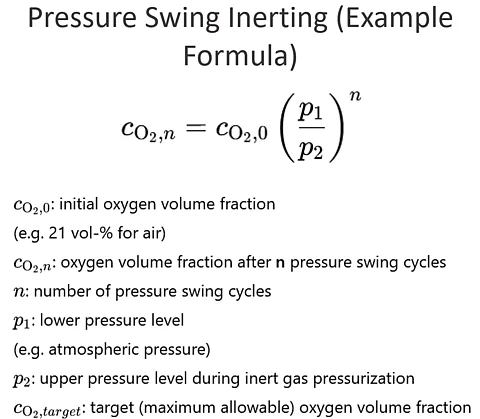
If the method is described based on the pressure ratio, it results in:
c_(O2,n) = c_(O2,0) * (p_(low)/p_(high))^n
- c_(O2,n) – oxygen content after n cycles
- c_(O2,0) – initial oxygen content
- p_(high) – pressure before evacuation (e.g. 1 bar abs)
- p_(low) – pressure after evacuation (e.g. 0.1 bar abs)
- n – number of evacuation/inert gas cycles
From both relationships, it is evident: The stronger the vacuum (i.e., the smaller p_(low)/p_(high) or the larger f) and the more cycles n are performed, the lower the residual oxygen content in the mixing chamber. This effectively reduces the risk of explosion and achieves a defined hygiene standard or product protection through a controlled inert gas atmosphere.