

Electrostatic charging
Electrostatic charge refers to the accumulation of electrical charge on the surface of a body without a continuous current flowing. A typical cause is the contact and subsequent separation of two materials (contact or friction electrification). This transfers electrons from one material to the other: the electron donor becomes positively charged, while the electron acceptor becomes negatively charged.
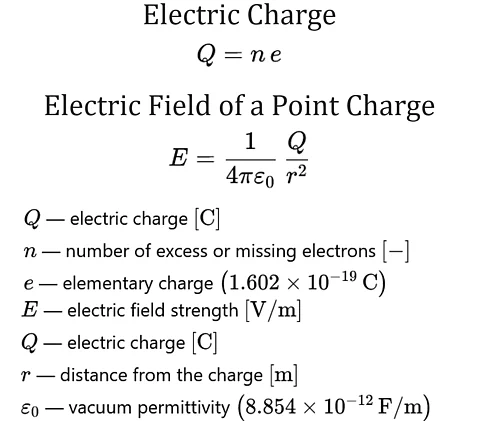
The charge of a body can be described by the electric charge Q:
Q = n · e
- Q: Charge [Coulomb]
- n: Number of excess or missing electrons
- e: elementary charge (1.602 × 10⁻¹⁹ C)
The associated electric field E depends on the charge and the distance. For a point charge in a vacuum, the following approximation applies:
E = (1 / (4 · π · ε_0)) · (Q / r^2)
- E: electric field strength [V/m]
- ε₀: electric field constant
r: Distance from the load Distance from the load
Electrostatic charging is a key issue in the industrial handling of bulk materials. During the conveying, dosing, mixing and, in particular, filling and packaging of powders and granulates, intensive contact and separation processes occur between product particles and plant components (pipes, conveyor systems, mixers, filling nozzles, film tubes). The poorer the conductivity of the materials involved and the drier the atmosphere, the more strongly the bulk material flow can become charged.
The danger arises less from the charge itself than from sudden discharge (electrostatic discharge, ESD). If a sufficiently high field strength is exceeded, sparking may occur. These sparks can
- ignite combustible dust-air mixtures or solvent vapours, thereby causing an explosion hazard.
- damage sensitive sensors or electronic components and
- In addition, adhesions, bridging or blockages can occur in conveyor lines, sieves and filling nozzles.
When packaging bulk goods, several effects occur simultaneously: the product rubs against the packaging film, the film rubs against mould shoulders, pull-off belts and deflection rollers, and the package is often moved at high cycle rates. This promotes high load levels. Typical phenomena are:
- Adhesion of powder particles to film and viewing windows,
- Light particles "fly" when opening,
- Difficulties in precise dosing because the product sticks to walls, weld seams or sensors.
- In addition, undesirable attraction or repulsion of bags or trays may occur.
Several control variables are available for technically influencing electrostatic charging.
- Material selection: - Use of conductive or dissipative materials for parts that come into contact with the product.
- suitable soils
- Equipotential bonding.
- Air conditioning: An increase in humidity in the process room typically reduces the maximum possible charge.
- Process control: Limitation of fall heights, speeds and impact energies, as well as the design of deflections, inlets and outlets.
- Active discharge: Ionisation bars, blower ionisers or discharge systems are used in the area of filling and packaging machines, especially in the film feed area.