

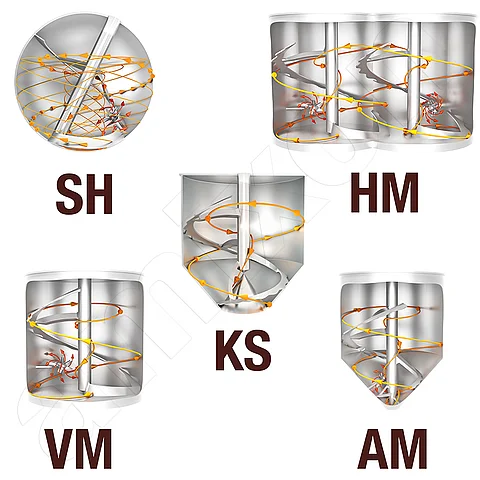
diffusion process
The flow-through process refers to the sequence of events involved in the flow of fluid or bulk material through a piece of equipment or process volume. In this process, fluids or bulk materials are set in motion by external forces and repeatedly pass through different areas of the process space. The aim is to actively incorporate all zones of the equipment into the process. In process engineering, the flow process is crucial for the homogenisation of composition, temperature and moisture. A uniform flow process prevents stagnant zones and dead spaces. This improves mixing quality, heat transfer and mass transfer.
In powder mixers, the flow process describes the continuous rearrangement and redistribution of the particles. Ideally, all particles pass repeatedly through the main flow circuit. This results in reproducible process characteristics and consistent product quality.
For the screw ribbon mixers shown on the left (vertical or slightly inclined), the following applies to the volume flow:
IV = (π/4) · (D² − d²) · φ · S · n · ζ
- IV = flow rate
- D = outer diameter
- d = internal diameter
- φ = fill level
- S = Gradient
- n = rotational speed
- ζ = flow coefficient/efficiency
The flow process is influenced by the equipment geometry, mixing mechanism, rotational speed, fill level and product properties. It can be specifically controlled through design and is a key design criterion for mixers, reactors and dryers.
 Blog
Blog