

Clausius-Clapeyron equation
The Clausius-Clapeyron equation in differential form:
d(ln p)/dT = ΔH_V / (R · T^2)
In the practical, integrated form, the Clausius-Clapeyron equation reads, for example:
ln(p_2/p_1) = - (ΔH_V / R) · (1/T_2 - 1/T_1)
- p₁, p₂: equilibrium vapor pressure of the liquid at the temperatures T₁ and T₂, respectively
- T1, T2: absolute temperatures in Kelvin
- R: universal gas constant
- ΔHV: molar enthalpy of vaporization
The equation shows: As the temperature rises, the vapor pressure increases exponentially; conversely, the vapor pressure decreases significantly when the temperature is lowered. For a given L, one can, for example, calculate how the "boiling point" of a liquid changes when the pressure is reduced (vacuum). This is exactly what is crucial for gentle evaporation and drying processes.
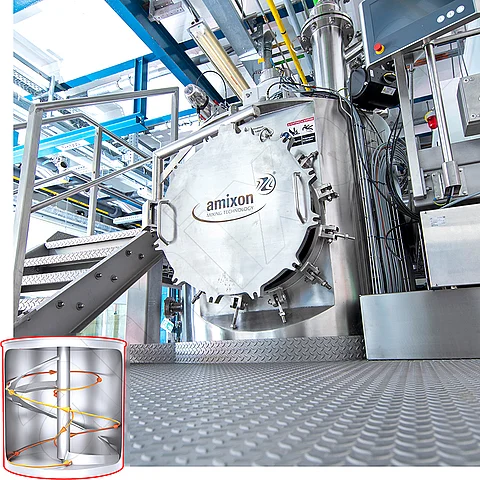
When a liquid is evaporated in the amixon® apparatus, operation is often under reduced pressure: Lowering the pressure decreases the boiling temperature, and the liquid can evaporate at lower product temperatures.
When the liquid is largely removed, the process transitions into the range of residual drying. In this range, only thin films or capillary liquid remain in the powder. Here, diffusion and heat and mass transfer in the solid determine the drying rate. The Clausius-Clapeyron relation continues to describe the equilibrium vapor pressure at the surface, while the amixon® dryers, through temperature control, vacuum and movement of the bulk material, ensure that the remaining liquid can fully evaporate until a free-flowing powder results.